
Wednesday, 10 June
Science
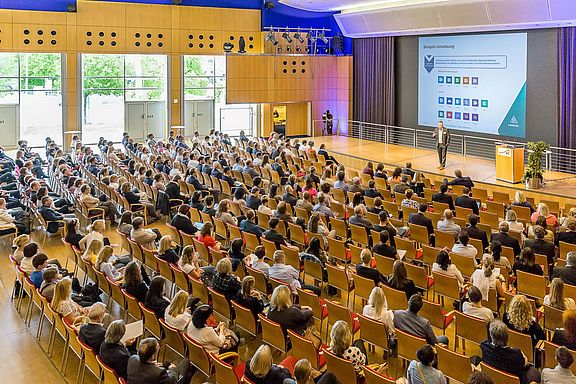
Day 1 approaches the conference theme from a scientific perspective. In various conference formats, such as presentations and poster sessions, participants present their latest research findings and discuss advancements in the field.
09:00 - 10:00 | Registration and welcome coffee |
10:00 - 10:45 | Opening ceremony |
10:45 - 11:30 | Keynote: “Fences, Fortunes and Failures: The Legacy of Property”Dirk Philipsen |
11:30 - 12:30 | Parallel presentation sessionsConsumer Behavior / Education & ResearchAgriculture & Food |
12:30 - 13:30 | Lunch and exhibition |
13:30 - 14:30 | Parallel presentation sessionsEducation & ResearchAgriculture & Food |
14:30 - 15:15 | KeynoteSigrid Stagl |
15:15 - 16:00 | Coffee break and exhibition |
16:00 - 18:00 | Parallel presentation sessionsBoundaries & Post-GrowthCommon-Good-Oriented Management StrategiesRegional Transformation & Resilience |
18:00 - 19:45 | Dinner |
19:45 - 20:45 | Round table discussion: “What do future generations need from the present?”Dirk Philipsen |
Download the Book of Abstracts to view summaries of the presentations given in the parallel sessions.
Book of Abstracts
10 June - Morning Sessions, Part 1
Time | Room 1+2Consumer Behavior / Education & ResearchSession Chair: Matthias Lederer | Room 3+4+5Agriculture & FoodSession Chair: Roland Menges |
11:30 - 11:50 | Consumers in the Economy for the Common Good - Development of an Evaluation FrameworkChristoph Harrach, Sarah Pinno, Christian Einsiedel | Golden Rules of Business Ethics and the Common Good: Virtue and Personalism in Sustainable Food SystemsYating Tian, Qeis Kamran, Patrick Baretto |
11:50 - 12:10 | Polis Can Depolarize its Participants! But Not Significantly?Florian Wagner | Forest Governance in Valais: A Historical Analysis Using the CIS FrameworkNoemi Imboden, Stéphane Genoud |
12:10 - 12:30 | Redefining Sustainable Marketing Research: Empirical, Quantitative, and Theoretical SuperiorityQeis Kamran, Patrick Baretto | SSbD Framework for Circular Economy Business Models Based on Agricultural WasteFernando Castelló-Sirvent, Pablo Pinazo-Dallenbach, Pascual Cortés-Pellicer, Vanessa Roger-Monzó |
10 June - Morning Sessions, Part 2
Time | Room 1+2Education & ResearchSession Chair: Matthias Lederer | Room 3+4+5Agriculture & FoodSession Chair: Roland Menges |
13:30 - 13:50 | Unveiling Research Trajectories and Knowledge Gaps in the Circular Economy: A Multi-Method Bibliometric and Topic Modeling Analysis (1981-2025)Qeis Kamran, Patrick Baretto | Scenario Modelling of Forest Governance in Zermatt Using a Qualitative System Dynamics ApproachNoemi Imboden, Stéphane Genoud |
13:50 - 14:10 | Transforming Economics Education through Circular Economy and Sustainability PrinciplesHammna Jillani, Hesan Zahid, Mojmír Sabolovič |
10 June - Afternoon Sessions
Time | Main HallCommon-Good-Oriented | Room 1+2Boundaries & Post-Growth | Room 3+4+5Regional Transformation & |
16:00-16:20 | Framework and Strategies for the Deployment of Artificial Intelligence in Public Welfare OrganizationsMaximilian Schultz, Franziska Hauer, Sonja Haug, Karsten Weber | Evaluating Post-Growth Value Creation in Enterprises: A Scoping ReviewJonneke de Koning, Kaj Morel, Jos Bijman | A Comprehensive Wellbeing Assessment in Cost-Benefit Analysis: A Review of Flood Adaptation Case StudiesAnoek van Tilburg, Kees van Ginkel, |
16:20-16:40 | Sustainability Benefits for the Business Manager's Mindset: | Ethical World Trade - Economy for the Common Good on a Global LevelBrigitta Herrmann, Christian Felber | The Dynamic Interplay of Economic, Institutional, and Transportation Factors in Cross-Border EmploymentCarmen-Raluca Spataceanu, Dominic Scholze, Maren Martens |
16:40-17:00 | Human Dignity in Different Economic Models Compared to the Economy for the Common GoodThomas Schiffelmann | Ecocide, A Lens on Declining Sustainability Infrastructures and Their Environmental and Human Impacts, and Rebuilding within | Common-Good-Oriented Participation and Individual Behavior in Circular Regions (CoRe-Lab)Michael Henke, Roland Menges, Michael Hahn |
17:00-17:20 | Social Value Generated by the Labor Inclusion of Vulnerable Youth: The Hispaled CaseBárbara Calderón Gómez-Tejedor | Re-evaluating the Unsustainable German Material Footprint towards a Sufficiency Oriented Demand-side ReductionNicolas Ehrhardt, Manuel W. Bickel, Christa Liedtke | |
17:20-17:40 | Futures at Work: Labor Unions’ Viewpoints on Employee-Level Social and Environmental SustainabilityStef van Dongen | Commons-Governed Automation as Material Infrastructure for an Economy for the Common Good (Video)Eduardo César Garrido Merchán |
|
Thursday, 11 June
Practice
Day 2 focuses on real-world examples of good practice. Practitioners from different sectors, regional development managers and practice-oriented researchers share first-hand experiences in implementing fair and sustainable business practices.
08:30 - 09:00 | Welcome coffee |
09:00 - 09:45 | Keynote: “Imagining 2050 Today: 3 Decades of Transforming to an Economy for the Common Good”Lewis Akenji |
09:45 - 10:00 | Switch to presentation rooms |
10:00 - 12:00 | Parallel presentation sessionsBoundaries & Post-Growth / Agriculture & FoodCommon-Good-Oriented Management Strategies |
12:00 - 13:00 | Lunch and exhibition |
13:00 - 13:45 | Keynote: “Fair Salaries through Transparency”Alma Spribille |
13:45 - 14:30 | Keynote: “Organic Farming, Basis for the Common Good - A Philosophical and Economic Perspective”Thomas Lang |
14:30 - 15:00 | Coffee break and exhibition |
15:00 - 17:00 | Parallel presentation sessionsEducation & ResearchCommon-Good-Oriented Management StrategiesRegional Transformation & Resilience |
17:00 - 18:30 | Dinner |
18:30 - 19:00 | Performance lecture: “Growing Up with Community Scale and Home-Made Biogas: Living the ‘Vortical Economy’”Thomas H. Culhane and Kilian Culhane |
19:00 - 19:30 | Location switch to Kongregationssaal |
19:30 - 20:30 | Choir concert “Art Vokal” at Kongregationssaal |
Download the Book of Abstracts to view summaries of the presentations given in the parallel sessions.
Book of Abstracts
11 June - Morning Sessions
Time | Room 1+2Common-Good-Oriented Management StrategiesSession Chair: Lisa Ranisch | Room 3+4+5Boundaries & Post-Growth / Agriculture & FoodSession Chair: Roland Menges |
10:00 - 10:20 | How to Break Free from Self-Fulfilling Mental Models in Complex Business Problems?Oliver Huffman | Applying the Doughnut Economics Framework to CaliforniaFranziska Raedeker |
10:20 - 10:40 | Reporting Requirements in the Transition from the ECG Framework to the ESRS VSMEErika Obermayr, Josef Baumüller | Unifying Sustainability and Democracy: Building a Network of Transition Coordination PlatformsPeter Bootsma, Jacqueline Hofstede |
10:40 - 11:00 | Beyond Profit: Redefining Business as a Vehicle for the Common Good (Video)Adina-Iuliana Deacu | Targeted Groundwater Protection Through Digital Precision AgricultureMartin Mittermayer, Ludwig Hagn, Josef Stangl, Johannes Schuster, |
11:00 - 11:20 | How to Design Products for Circular Economy? When w∞d.ii Meets the ECOnGOOD Business CanvasRobert Böker, Hartmut Schäfer | Möhren und Marillen: Rethinking Food Waste at the Local Level to Improve the Circular Economy (Theatrical Dialogue)Thomas Culhane, Katrin Puetz |
11 June - Afternoon Sessions
Time | Main HallRegional Transformation & | Room 1+2Common-Good-Oriented | Room 3+4+5Education & Research |
15:00-15:20 | A Vision for Landshut 2045Katharina Anna Schlecht, Stephanie Mennle, Saskia Rimat | Doughnut Economics for Regenerative Business DesignNelly Rahimy, Annekatrin Meißner, Suleika Bort | Sustainability Education as Aim across the Institution and its ProgramsSabine Spangenberg |
15:20-15:40 | Economic Viability and Social Robustness of Intentional Communities: A Case StudyMaartje Visser | A Balanced Scorecard Development from the Perspective of the Common Good EconomyWolfgang Gehra, Sabine Thiele, Kim Klein | Example of Good Practice: W(u)eShare- Participate Through Involvement - Swap Cupboards on University Campus to Promote Social InteractionsTimo Stiller |
15:40-16:00 | Driving the Transition towards a Common Good Region: A Social Entrepreneurship Initiative by Kempten University of Applied SciencesLisa Gebler, Marina Bergler | Integrating Committed Engineering and the Economy for the Common Good into the Design of an Organizational Management Model for BIC Companies in ColombiaSandra Milena Bonilla Cely | A Curriculum for Common Good EconomicsSophie Friedl |
16:00-16:20 | Readiness as Enabling Conditions: Operationalizing the Social and Solidarity Economy through the Ready Communities ModelChad Renando, Kerry Grace | Matter, Process, Structure – A Living Systems Approach to Designing Organizations and ProjectsKathy Otto | Learning Experiences for a Fair and Sustainable EconomyCarina Kamptner, Petra Isepp |
16:20-16:40 | Rail Infrastructure for the Common Good in Germany: How Political Ambitions Play Out in PracticeDominic Jung | ESG + C2 Quality SystemVíctor Fernández Morales | |
16:40-17:00 | How Can Psychology Contribute to Societal Transformation? Insights from Doing Participatory Action ResearchNilima Chowdhury |
|
Friday, 12 June
Transformation
Day 3 fosters closer interaction between science and practice. The workshop sessions aim to promote transdisciplinary research and actively stimulate the identification and implementation of joint, actionable pathways for transformative change.
09:00 - 09:30 | Welcome coffee |
09:30 - 10:15 | Keynote: “Enabling Trust - Economy for the Common Good through Relationships”Antoinette Weibel |
10:15 - 10:30 | Switch to presentation rooms |
10:30 - 12:30 | Parallel workshop sessions |
12:30 - 13:45 | Lunch and exhibition |
13:45 - 14:30 | Keynote: “Tackling Excessive Wealth Concentration and Inequality: Social Boundaries as the Twin Sister of Planetary Boundaries”Christian Felber |
14:30 - 15:00 | Closing ceremony |
15:00 - 15:45 | End of the conference |
15:45 - 18:00 | Constituent meeting of the ECG Scientific Council (upon invitation only) |
12 June - Workshop Sessions
Main Hall | Room 1+2 |
The “TAPAS Gallery” Project - Highlighting Future-Fit Economic Models | Systems Thinking: The Nature of Complexity and How to Solve Complex Problems (for the Common Good)Capacity: 20-40 participants Facilitator: Oliver Huffman |
The "TAPAS Gallery" Project - Workshop Description
Departing from a project started at the World Ethic Forum 2024 in Pontresina, a collective of researchers, activists and artists tries to identify the most promising future-fit economic models that are discussed and practiced. The models we envision and want to make visible and embody social justice, solidarity, inclusion, democracy, and sustainability. We call the selection “The TAPAS Gallery” and our plan is to disseminate this gallery in an approachable and experiential way for broad audiences.
According to the slogan “TAPAS”: “There are plenty of alternatives!” we call the project “The TAPAS gallery”. The models will be selected according to criteria such as equitable, deeply sustainable/ regenerative, participatory/inclusive, and they need to have been proven in successful practices. We want to make them visible in a comparative overview according to categories that allow to describe, characterize and understand them easily and quickly. We took inspiration from a similar project: “Exploring Economics”. This “gallery” was created in the field of theoretical schools of economics (https://www.exploring- economics.org/de/). This matrix showcases relevant heterodox schools of thought in the field of economics next to the dominant mainstream school of neoclassical economics. We want to undertake the “next step” showcasing the most widely discussed, practical, and convincing future-fit economic models.
By highlighting these diverse approaches, we hope to inspire actionable change towards economies that truly serve the many, not the few. We want to share knowledge about these models and also try to facilitate conversations, collaboration, and convergence across different approaches. They can be used by teachers, policy makers and the media to rethink and relearn the economy. Together, these alternative frameworks offer a tapestry of solutions that meet the diverse needs of our global future. Together, they can become the economic foundation of tomorrow - one rooted in justice, equity, and sustainability for all.
Systems Thinking - Workshop Description
How can we solve problems in an increasingly complex world? Knowing how to solve complex problems could mean the success or failure of your next big project. In this workshop, you will learn how complexity affects world economies, societies, the environment or organizations. Then, we will learn a method for mapping and solving problems in complex systems such as rural economies or multinational organizations. This workshop will be useful for business leaders, political leaders, social-entrepreneurs and researchers, who want to learn how to visualize the complexity of the world. This workshop will also be interesting to Master’s students and PhD students looking for a new way of researching.
12 June - Workshop Sessions
Room 3+4+5 | Room at Stadtwerke Amberg |
|
|
Task Democracy Experiment - Workshop Description
As the polycrisis unfolds and mankind is failing to turn the tide, the sustainability movement knows very well it needs to step up its efforts. In our circles we see many gatherings where this awareness is central. Concepts for upscaling, however, often remain on the level of pilot projects and convening bottom-up actors in coalitions.
The drawback of this strategy is that it does not address what we see as a polycrisis root cause: the inability of political systems to organize sustainability transitions timely and effectively. In this workshop we research a different approach: convening the democratic top-level boards of networks and institutes from five mutually dependent transition task groups. Basically, this is designing a new political subsystem, which needs to be scalable, needs to be compatible with and acceptable for (liberal) democratic institutions and the sustainability movement and needs to be easy to proliferate.
Building Transformation - Workshop Description
Sustainability conferences often generate valuable discussions, but translating dialogue into concrete collaboration and implementation remains a challenge. This interactive workshop creates a space where participants from academia and practice collaboratively explore transformation challenges, develop shared system perspectives, and turn conference insights into actionable next steps.
Using LEGO® SERIOUS PLAY® as a renowned collaborative method, participants make complex relationships and transformation dynamics visible through tangible models. Together, they identify interdependencies, tensions, and leverage points between science, practice, and society, while reflecting on how sustainable transformation can shift from isolated initiatives toward meaningful cooperation.
The workshop is designed as a focused collaboration format for a small group of participants from diverse sectors and disciplines. Beyond reflection and exchange, participants develop concrete short-term collaboration ideas and outline practical next steps for implementation over the next 12 months.
In addition to collaborative modeling and reflection, the workshop supports networking between science, practice, and transformation-oriented actors through facilitated exchange and networking materials. Workshop outcomes, visual documentation, and collaborative insights will contribute to a post-conference communication and exhibition format accompanying the ECGIC 2026 after movie and dissemination activities.
Outcome:
Shared transformation models, documented collaboration impulses, and concrete next steps for cooperation emerge from the conference dialogue.
Wednesday, 10 June
Science
Day 1 approaches the conference theme from a scientific perspective. In various conference formats, such as presentations and poster sessions, participants present their latest research findings and discuss advancements in the field.
09:00 - 10:00 | Registration and welcome coffee |
10:00 - 10:45 | Opening ceremony |
10:45 - 11:30 | Keynote: “Fences, Fortunes and Failures: The Legacy of Property”Dirk Philipsen |
11:30 - 12:30 | Parallel presentation sessionsConsumer Behavior / Education & ResearchAgriculture & Food |
12:30 - 13:30 | Lunch and exhibition |
13:30 - 14:30 | Parallel presentation sessionsEducation & ResearchAgriculture & Food |
14:30 - 15:15 | Keynote Sigrid Stagl |
15:15 - 16:00 | Coffee break and exhibition |
16:00 - 18:00 | Parallel presentation sessionsBoundaries & Post-GrowthCommon-Good-Oriented Management StrategiesRegional Transformation & Resilience |
18:00 - 19:45 | Dinner |
19:45 - 20:45 | Round table discussion: “What do future generations need from the present?”Dirk Philipsen |
Download the Book of Abstracts to view summaries of the presentations given in the parallel sessions.
Book of Abstracts
10 June - Morning Sessions, Part 1
Room 1+2Consumer Behavior / Education & ResearchSession Chair: Matthias Lederer |
11:30 - 11:50Consumers in the Economy for the Common Good - Development of an Evaluation FrameworkChristoph Harrach, Sarah Pinno, Christian Einsiedel |
11:50 - 12:10Polis Can Depolarize its Participants! But Not Significantly?Florian Wagner |
12:10 - 12:30Redefining Sustainable Marketing Research: Empirical, Quantitative, and Theoretical SuperiorityQeis Kamran, Patrick Baretto |
Room 3+4+5Agriculture & FoodSession Chair: Roland Menges |
11:30 - 11:50Golden Rules of Business Ethics and the Common Good: Virtue and Personalism in Sustainable Food SystemsYating Tian, Qeis Kamran, Patrick Baretto |
11:50 - 12:10Forest Governance in Valais: A Historical Analysis Using the CIS FrameworkNoemi Imboden, Stéphane Genoud |
12:10 - 12:30SSbD Framework for Circular Economy Business Models Based on Agricultural WasteFernando Castelló-Sirvent, Pablo Pinazo-Dallenbach, Pascual Cortés-Pellicer, Vanessa Roger-Monzó |
10 June - Morning Sessions, Part 2
Room 1+2Education & ResearchSession Chair: Matthias Lederer |
13:30-13:50Unveiling Research Trajectories and Knowledge Gaps in the Circular Economy: A Multi-Method Bibliometric and Topic Modeling Analysis (1981-2025)Qeis Kamran, Patrick Baretto |
13:50-14:10Transforming Economics Education through Circular Economy and Sustainability PrinciplesHammna Jillani, Hesan Zahid, Mojmír Sabolovič |
Room 3+4+5Agriculture & FoodSession Chair: Roland Menges |
13:30-13:50Scenario Modelling of Forest Governance in Zermatt Using a Qualitative System Dynamics ApproachNoemi Imboden, Stéphane Genoud |
June 10 - Afternoon Sessions
Main HallCommon-Good-Oriented |
16:00 - 16:20Framework and Strategies for the Deployment of Artificial Intelligence in Public Welfare OrganizationsMaximilian Schultz, Franziska Hauer, Sonja Haug, Karsten Weber |
16:00 - 16:20Sustainability Benefits for the Business Manager's Mindset: a Strategic Framework for Understanding Positive ImpactJose Carlos Ramos, Natalia Cugueró-Escofet, Ricard Espelt |
16:40 - 17:00Human Dignity in Different Economic Models Compared to the Economy for the Common GoodThomas Schiffelmann |
17:00 - 17:20Social Value Generated by the Labor Inclusion of Vulnerable Youth: The Hispaled CaseBárbara Calderón Gómez-Tejedor |
17:20 - 17:40Futures at Work: Labor Unions’ Viewpoints on Employee-Level Social and Environmental SustainabilityStef van Dongen |
Room 1+2Boundaries & Post-GrowthSession Chair: Mojmír Sabolovič |
16:00 - 16:20Evaluating Post-Growth Value Creation in Enterprises: A Scoping ReviewJonneke de Koning, Kaj Morel, Jos Bijman |
16:20 - 16:40Ethical World Trade - Economy for the Common Good on a Global LevelBrigitta Herrmann, Christian Felber |
16:40 - 17:00Ecocide, A Lens on Declining Sustainability Infrastructures and Their Environmental and Human Impacts, and Rebuilding within |
17:00 - 17:20Re-evaluating the Unsustainable German Material Footprint towards a Sufficiency Oriented Demand-side ReductionNicolas Ehrhardt, Manuel W. Bickel, Christa Liedtke |
17:20 - 17:40Commons-Governed Automation as Material Infrastructure for an Economy for the Common Good (Video)Eduardo César Garrido Merchán |
Room 3+4+5Regional Transformation & |
16:00 - 16:20A Comprehensive Wellbeing Assessment in Cost-Benefit Analysis: A Review of Flood Adaptation Case StudiesAnoek van Tilburg, Kees van Ginkel, Jan Brusselaers, Wouter Botzen |
16:40 - 17:00The Dynamic Interplay of Economic, Institutional, and Transportation Factors in Cross-Border EmploymentCarmen-Raluca Spataceanu, Dominic Scholze, Maren Martens |
17:00 - 17:20Common-Good-Oriented Participation and Individual Behavior in Circular Regions (CoRe-Lab)Michael Henke, Roland Menges, Michael Hahn |
Thursday, 11 June
Practice
Day 2 focuses on real-world examples of good practice. Practitioners from different sectors, regional development managers and practice-oriented researchers share first-hand experiences in implementing fair and sustainable business practices.
08:30 - 09:00 | Welcome coffee |
09:00 - 09:45 | Keynote: “Imagining 2050 Today: 3 Decades of Transforming to an Economy for the Common Good”Lewis Akenji |
09:45 - 10:00 | Switch to presentation rooms |
10:00 - 12:00 | Parallel presentation sessionsBoundaries & Post-Growth / Agriculture & FoodCommon-Good-Oriented Management Strategies |
12:00 - 13:00 | Lunch and exhibition |
13:00 - 13:45 | Keynote: “Fair Salaries through Transparency”Alma Spribille |
13:45 - 14:30 | Keynote: “Organic Farming, Basis for the Common Good - A Philosophical and Economic Perspective”Thomas Lang |
14:30 - 15:00 | Coffee break and exhibition |
15:00 - 17:00 | Parallel presentation sessionsEducation & ResearchCommon-Good-Oriented Management StrategiesRegional Transformation & Resilience |
17:00 - 18:30 | Dinner |
18:30 - 19:00 | Performance lecture: “Growing Up with Community Scale and Home-Made Biogas: Living the ‘Vortical Economy’”Thomas H. Culhane and Kilian Culhane |
19:00 - 19:30 | Location switch to Kongregationssaal |
19:30 - 20:30 | Choir concert “Art Vokal” at Kongregationssaal |
Download the Book of Abstracts to view summaries of the presentations given in the parallel sessions.
Book of Abstracts
11 June - Morning Sessions
Room 1+2Common-Good-Oriented |
10:00 - 10:20How to Break Free from Self-Fulfilling Mental Models in Complex Business Problems?Oliver Huffman |
10:20 - 10:40Reporting Requirements in the Transition from the ECG Framework to the ESRS VSMEErika Obermayr, Josef Baumüller |
10:40 - 11:00Beyond Profit: Redefining Business as a Vehicle for the Common Good (Video)Adina-Iuliana Deacu |
11:00 - 11:20How to Design Products for Circular Economy? When w∞d.ii Meets the ECOnGOOD Business CanvasRobert Böker, Hartmut Schäfer |
Room 3+4+5Boundaries & Post-Growth / Agriculture & FoodSession Chair: Roland Menges |
10:00 - 10:20Applying the Doughnut Economics Framework to CaliforniaFranziska Raedeker |
10:20 - 10:40Unifying Sustainability and Democracy: Building a Network of Transition Coordination PlatformsPeter Bootsma, Jacqueline Hofstede |
10:40 - 11:00Targeted Groundwater Protection Through Digital Precision AgricultureMartin Mittermayer, Ludwig Hagn, Josef Stangl, Johannes Schuster, Kurt-Jürgen Hülsbergen |
11:00 - 11:20Möhren und Marillen: Rethinking Food Waste at the Local Level to Improve the Circular Economy (Theatrical Dialogue)Thomas Culhane, Katrin Puetz |
11 June - Afternoon Sessions
Main HallRegional Transformation & |
15:00 - 15:20A Vision for Landshut 2045Katharina Anna Schlecht, Stephanie Mennle, Saskia Rimat |
15:20 - 15:40Economic Viability and Social Robustness of Intentional Communities: A Case StudyMaartje Visser |
15:40 - 16:00Driving the Transition towards a Common Good Region: A Social Entrepreneurship Initiative by Kempten University of Applied |
16:00 - 16:20Readiness as Enabling Conditions: Operationalizing the Social and Solidarity Economy through the Ready Communities ModelChad Renando, Kerry Grace |
16:20 - 16:40Rail Infrastructure for the Common Good in Germany: How Political Ambitions Play Out in PracticeDominic Jung |
16:40 - 17:00How Can Psychology Contribute to Societal Transformation? Insights from Doing Participatory Action ResearchNilima Chowdhury |
Room 1+2Common-Good-Oriented |
15:00 - 15:20Doughnut Economics for Regenerative Business DesignNelly Rahimy, Annekatrin Meißner, Suleika Bort |
15:20 - 15:40A Balanced Scorecard Development from the Perspective of the Common Good EconomyWolfgang Gehra, Sabine Thiele, Kim Klein |
15:40 - 16:00Integrating Committed Engineering and the Economy for the Common Good into the Design of an Organizational Management Model for BIC Companies in ColombiaSandra Milena Bonilla Cely |
16:00 - 16:20Matter, Process, Structure – A Living Systems Approach to Designing Organizations and ProjectsKathy Otto |
16:20 - 16:40ESG + C2 Quality SystemVíctor Fernández Morales |
Room 3+4+5Education & ResearchSession Chair: Julia Kreppmeier |
15:00 - 15:20Sustainability Education as Aim across the Institution and its ProgramsSabine Spangenberg |
15:20 - 15:40Example of Good Practice: W(u)eShare- Participate Through Involvement - Swap Cupboards on University Campus to Promote |
15:40 - 16:00A Curriculum for Common Good EconomicsSophie Friedl |
16:00 - 16:20Learning Experiences for a Fair and Sustainable EconomyCarina Kamptner, Petra Isepp |
Friday, 12 June
Transformation
Day 3 fosters closer interaction between science and practice. The workshop sessions aim to promote transdisciplinary research and actively stimulate the identification and implementation of joint, actionable pathways for transformative change.
09:00 - 09:30 | Welcome coffee |
09:30 - 10:15 | Keynote: “Enabling Trust - Economy for the Common Good through Relationships”Antoinette Weibel |
10:15 - 10:30 | Switch to presentation rooms |
10:30 - 12:30 | Parallel workshop sessions |
12:30 - 13:45 | Lunch and exhibition |
13:45 - 14:30 | Keynote: “Tackling Excessive Wealth Concentration and Inequality: Social Boundaries as the Twin Sister of Planetary Boundaries”Christian Felber |
14:30 - 15:00 | Closing ceremony |
15:00 - 15:45 | End of the conference |
15:45 - 18:00 | Constituent meeting of the ECG Scientific Council (upon invitation only) |
12 June - Workshop Sessions
Main Hall |
10:30 - 12:30The “TAPAS Gallery” Project - Highlighting Future-Fit Economic ModelsCapacity: 25-50 participants Facilitator: Christian Felber |
The "TAPAS Gallery" Project - Workshop Description
Departing from a project started at the World Ethic Forum 2024 in Pontresina, a collective of researchers, activists and artists tries to identify the most promising future-fit economic models that are discussed and practiced. The models we envision and want to make visible and embody social justice, solidarity, inclusion, democracy, and sustainability. We call the selection “The TAPAS Gallery” and our plan is to disseminate this gallery in an approachable and experiential way for broad audiences.
According to the slogan “TAPAS”: “There are plenty of alternatives!” we call the project “The TAPAS gallery”. The models will be selected according to criteria such as equitable, deeply sustainable/ regenerative, participatory/inclusive, and they need to have been proven in successful practices. We want to make them visible in a comparative overview according to categories that allow to describe, characterize and understand them easily and quickly. We took inspiration from a similar project: “Exploring Economics”. This “gallery” was created in the field of theoretical schools of economics (https://www.exploring- economics.org/de/). This matrix showcases relevant heterodox schools of thought in the field of economics next to the dominant mainstream school of neoclassical economics. We want to undertake the “next step” showcasing the most widely discussed, practical, and convincing future-fit economic models.
By highlighting these diverse approaches, we hope to inspire actionable change towards economies that truly serve the many, not the few. We want to share knowledge about these models and also try to facilitate conversations, collaboration, and convergence across different approaches. They can be used by teachers, policy makers and the media to rethink and relearn the economy. Together, these alternative frameworks offer a tapestry of solutions that meet the diverse needs of our global future. Together, they can become the economic foundation of tomorrow - one rooted in justice, equity, and sustainability for all.
Room 1+2 |
10:30 - 12:30Systems Thinking: The Nature of Complexity and How to Solve Complex Problems (for the Common Good)Capacity: 20-40 participants Facilitator: Oliver Huffman |
The Nature of Complexity - Workshop Description
How can we solve problems in an increasingly complex world? Knowing how to solve complex problems could mean the success or failure of your next big project. In this workshop, you will learn how complexity affects world economies, societies, the environment or organizations. Then, we will learn a method for mapping and solving problems in complex systems such as rural economies or multinational organizations. This workshop will be useful for business leaders, political leaders, social-entrepreneurs and researchers, who want to learn how to visualize the complexity of the world. This workshop will also be interesting to Master’s students and PhD students looking for a new way of researching.
Room 3+4+5 |
10:30 - 12:30Task Democracy ExperimentCapacity: min. 5, max. 30 participants Facilitators: Peter Bootsma, Jacqueline Hofstede |
Task Democracy Experiment - Workshop Description
As the polycrisis unfolds and mankind is failing to turn the tide, the sustainability movement knows very well it needs to step up its efforts. In our circles we see many gatherings where this awareness is central. Concepts for upscaling, however, often remain on the level of pilot projects and convening bottom-up actors in coalitions.
The drawback of this strategy is that it does not address what we see as a polycrisis root cause: the inability of political systems to organize sustainability transitions timely and effectively. In this workshop we research a different approach: convening the democratic top-level boards of networks and institutes from five mutually dependent transition task groups. Basically, this is designing a new political subsystem, which needs to be scalable, needs to be compatible with and acceptable for (liberal) democratic institutions and the sustainability movement and needs to be easy to proliferate.
Room at Stadtwerke Amberg |
10:30 - 12:30Building Transformation: From Conference Dialogue to Collaborative ActionCapacity: 12 participants Facilitators: Ruhul Amin Noel, Maria Pusoma, Gabriele M. Murry |
Building Transformation - Workshop Description
Sustainability conferences often generate valuable discussions, but translating dialogue into concrete collaboration and implementation remains a challenge. This interactive workshop creates a space where participants from academia and practice collaboratively explore transformation challenges, develop shared system perspectives, and turn conference insights into actionable next steps.
Using LEGO® SERIOUS PLAY® as a renowned collaborative method, participants make complex relationships and transformation dynamics visible through tangible models. Together, they identify interdependencies, tensions, and leverage points between science, practice, and society, while reflecting on how sustainable transformation can shift from isolated initiatives toward meaningful cooperation.
The workshop is designed as a focused collaboration format for a small group of participants from diverse sectors and disciplines. Beyond reflection and exchange, participants develop concrete short-term collaboration ideas and outline practical next steps for implementation over the next 12 months.
In addition to collaborative modeling and reflection, the workshop supports networking between science, practice, and transformation-oriented actors through facilitated exchange and networking materials. Workshop outcomes, visual documentation, and collaborative insights will contribute to a post-conference communication and exhibition format accompanying the ECGIC 2026 after movie and dissemination activities.
Outcome:
Shared transformation models, documented collaboration impulses, and concrete next steps for cooperation emerge from the conference dialogue.