Projects and Research
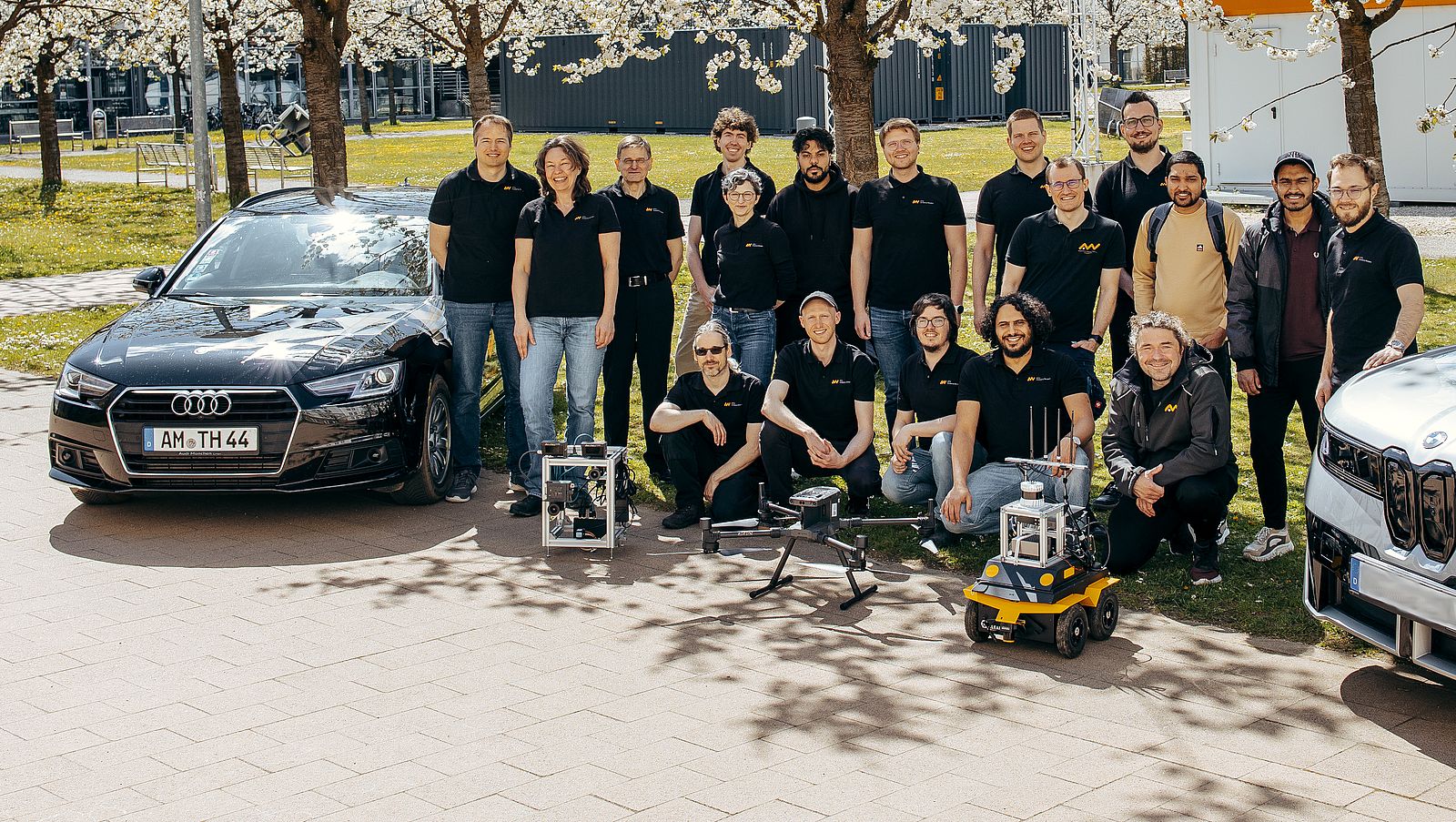
Team Automotive is involved in multiple EU backed research projects focussed on automotive driving and Artificial Intelligence.
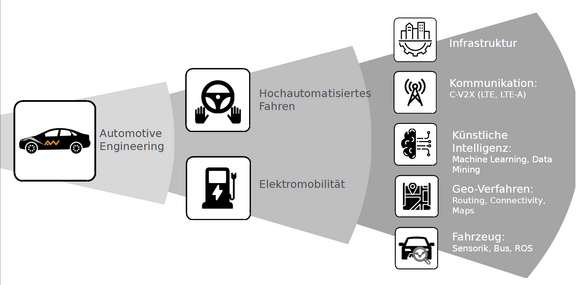
Research topics
- AI Algorithms
- EV Mobility
- Autonomous Driving
- Sensor Data processing
Projects
Ongoing Projects
A-IQ Ready – Artificial Intelligence using Quantum measured Information for distributed real-time systems at the edge of the network

A-IQ Ready proposes cutting-edge quantum sensing, edge continuum orchestration of AI and distributed collaborative intelligence technologies to implement the vision of intelligent and autonomous ECS for the digital age. Quantum magnetic flux and gyro sensors enable highest sensitivity and accuracy without any need for calibration, offer unmatched properties when used in combination with a magnetic field map. Such a localization system will enhance the timing and accuracy of the autonomous agents and will reduce false alarms or misinformation by means of AI and multi-agent system concepts.
By exploring the synergies of these cutting-edge technologies through civil safety and security, digital health, smart logistics for supply chains and propulsion use cases, A-IQ Ready will provide the basis for the digital society in Europe based on values, moving towards the ideal of Society 5.0.
Vision:
- Develop an edge continuum orchestration for AI
- Provide a resource-efficient low-energy distributed system infrastructure for multi-agent applications
Goals:
- Provide AI methods for multi-agent autonomy in uncertain environments.
- Increase sensing accuracy, reliability and trustworthiness in complex environments with new sensors
- Provide an Open AI Edge continuum platform
- Build applications relevant for the digital society
Impact:
- Apply 3 disruptive technologies: quantum sensor, neuromorphic acceleration, AI in multi-agent systems to build the edge continuum as the digital backbone for the Society
ARCHIMEDES – Trusted lifetime in operation for a curcular economy
Development of a reliable and secure communication system for underground UGVs/UAVs, based on a digital twin of a search and rescue test site. Implementation of mechanisms for identifying failures and assessing the state of health and quality of service.
PowerizeD – Digitalization of Power Electronic Applications within Key Technology Value Chains

The overarching goal of PowerizeD is to develop groundbreaking technologies for digitalised and intelligent power electronics that enable sustainable and resilient energy generation, transmission and utilisation. PowerizeD increases the degree of mechanical and electrical integration of control, driver and switching functionality within a single component, enabling the joint optimisation of all power switch functions for the first time.
The use of new circuit models, advanced control strategies and artificial intelligence enables the integration of parts of the control loop, resulting in robust and reliable operation. To facilitate the sharing of data along the value chain, PowerizeD employs the novel approach of federated learning. This collaborative optimisation of specific compact models and neural networks
Shape Future - Ensuring European ECS Value Chain Sovereignty through Shaping the Future of ECS for Automotive Applications

Global industry has undergone radical developments, from manual manufacturing processes to industrial digitalisation and the introduction of robots, which are designed down to the smallest detail and require a deep understanding of complex products.
Industrial developments have so far been heavily influenced by electronic components and systems (ECS). In the course of these industrial (r)evolutions, ECS have evolved from simple vacuum tubes to highly integrated circuits, microprocessors, sensors, actuators and advanced communication technologies.
In the field of mobility in particular, ECS have contributed to major advances to date. For over a decade, perception-based solutions have been available for the mass market, preventing collisions and driving forward vehicle automation, for example. Furthermore, mobility is undergoing a profound transformation driven by a combination of factors ranging from environmental concerns to technological advances. This transformation is crucial for addressing challenges such as climate change, urban congestion and the need for more efficient and sustainable mobility solutions on the path towards zero-fatality mobility
VRUIDFUL – Vulnerable Road User Intention Detection for Urban Locations

The VRUIDFUL project aims to place a clear focus on expanding OTH Amberg-Weiden’s existing research in the field of mobility to include smart infrastructure (e.g. sensor technology, advanced traffic light systems). Specifically, the project aims to investigate the installation of such infrastructure in a real-world urban test environment and its integration into a comprehensive safety system for vulnerable road users (VRUs) across several phases: As part of this proposal, an area in Amberg that is particularly heavily frequented by vulnerable road users (VRUs) (around the university, daycare centre and nursery) is to be equipped with intelligent infrastructure units (IISE). These will be used to collect and analyse extensive data.
The sensor technology in the IISE is based on radar, lidar, thermal imaging and stereo cameras; the intelligence within the units is designed to detect and classify objects, in particular VRUs and groups of VRUs. The abstracted data obtained (3D cubes) is transmitted to a central server via mobile networks, ITS-G5 (and, in some cases, LoRa), stored there and can be used for further analysis. As only abstracted data is transmitted to and stored on the server, compliance with data protection regulations is guaranteed. In parallel, selected traffic light systems in the test field are to be upgraded with V2X communication units and a connection to the traffic control computer, enabling them to transmit traffic light phases in advance. This information is stored on the server in a time-synchronised manner. Additional data, such as weather conditions, will also be recorded to enable a well-founded evaluation of the influences of traffic light sequences and weather on the behaviour of vulnerable road users (VRUs).
Based on the research data obtained in this way, a second phase will involve initiating research projects on the intention recognition of vulnerable road users and their behaviour in collaboration with partners (e.g. from the Bavarian AI mobility network ‘AImotion’). The resulting findings will be used to derive warning strategies and recommendations for vehicle behaviour to address potentially dangerous scenarios (such as pedestrians or cyclists who, after a prolonged ‘green’ phase, wish to ‘quickly’ cross the road as the pedestrian traffic light turns ‘red’, or pedestrians walking inattentively behind a group of other vulnerable road users) at an early stage and prevent accidents.
The costs and benefits are to be assessed. In a third phase, these warning strategies and recommendations for action are to be discussed with the relevant stakeholders, i.e. transport planners, vehicle manufacturers, members of the public, etc. Initially, for example, a smartphone app could help to increase pedestrians’ awareness. The overall aim, however, would be to make the integrated system a reality through joint projects with vehicle manufacturers and transport planners, i.e. to incorporate not only pedestrians but also vehicles into the warning concept.
Finished Projects
1000kmplus

here is a clear need for shared, scalable and brand-independent technology platforms for the key components of electric vehicles (EVs), such as the inverter-motor-transmission (powertrain) and the battery. The 1000kmPLUS project will ensure the superiority of European automotive key technologies in terms of performance, scalability and cost
To achieve a breakthrough in terms of energy efficiency, range, charging and costs, the 1000kmPLUS project is developing a Scalable European Powertrain Technology Platform (SEPtop@SiC). Furthermore, ultra-fast charging at up to 350 kW is being demonstrated for everyday use in an electric vehicle which, based on its battery capacity, has an initial range of 500 km.
The project’s objectives are:
- Increasing the appeal of electric cars through greater range
- Validation on test routes of 1000, 2000 and 4500 km in length
- Development and optimisation of a routing application taking multiple factors into account
- (e.g. battery status, available charging stations)
- Increasing range through the use of powertrain technology
- Reducing journey time through shorter charging times
OTH-AW will develop the routing algorithms for the optimised routing system. The routing will be adapted to battery charge levels and various defined factors affecting the route. The routing system will select the most suitable charging station to reach destinations within Europe. In doing so, the battery’s charging characteristics will be taken into account and the system will provide recommendations for an energy-efficient route for the vehicle system.
3Ccar – Integrated Components for Complexitiy Control in affordable electrified cars

“Integrated Components for Complexity Control in Affordable Electrified Cars” – Promoting electric mobility by improving the reliability and fault tolerance of highly automated electric vehicles.
Server-based services delivered via mobile networks to optimise the range of electric vehicles.
The EU project 3Ccar was launched on 1 June 2015. OTH-AW is collaborating on this European Commission-funded project with almost 50 project partners under the leadership of Infineon. The aim of the project is to raise electric mobility to a new technical level and increase the market relevance of these vehicles. Project partners include Siemens, BMW, Daimler, AVL, TNO and NXP, as well as the universities of Dresden, Graz and Brno and the Fraunhofer Society. The project will run for three years.
The overall objective of the 3CCar project is to improve control of increased complexity by applying new approaches to nanotechnological components. This is intended to reduce failure rates and vehicle costs.
3CCar pursues two parallel societal goals: meeting social needs and maintaining global leadership. The project has significant implications for Europe’s innovation-driven industries through the creation of highly skilled jobs. The development and deployment of new capabilities introduced by electronics, components and systems are the key factors in achieving these objectives, as they will equip vehicles and transport systems with the necessary intelligence whilst simultaneously building on and further enhancing the established strengths of European industry.
The objectives of the 3Ccar project can be divided into six groups:
- Competitive advantages through more complex semiconductor-based systems
- Cost reduction of automotive components
- Managing complexity through architectures enables new subdivisions
- Reduction of vehicle maintenance costs
- Getting more electric vehicles on the roads, thereby replacing combustion engines
- Improving the carbon footprint of transport
The East Bavarian University of Applied Sciences Amberg-Weiden (OTH-AW), together with its project partners, will develop an extension to C2I (Car-to-Infrastructure) communication via an LTE connection specifically for electric vehicles. The network of electric vehicles is to be expanded via a 4G connection with high data rates and will be implemented using an LTE module connected to the network. Within the project, the LTE connection will be evaluated with regard to the appropriate data link to the vehicle environment. The electric vehicle’s on-board network is accessed via various automotive interfaces, such as Ethernet or CAN, whereby the architecture must take into account the various safety aspects relating to communication between the electric vehicle and its environment.
ADACORSA – Airborne data collection on resilient system architectures

ADACORSA is set to supply the technical components (hardware, software, expertise and procedures) required to operate semi-autonomous drones beyond visual line of sight (BVLOS) in both uncontrolled (very low-level) airspace and controlled airspace, all under a pricing policy that is unprecedented. This is intended to prepare German and European partners for the use of semi-automated or fully autonomous drones in BVLOS operations, so that they can shape this market with new business models in the future.
OTH-AW focuses on drone communication in relation to BVLOS scenarios, and in particular on the two aspects of reliability (Reliability, Safety) and security (Security). To contribute to reliable communication between drones and operators, OTH-AW is researching and developing models for predicting mobile network connection quality. Based on real-world airborne measurements, various algorithms – from the field of machine learning or geo-based methods – are to be developed and evaluated for their suitability for the prediction models. The models developed will then be utilised by the Dutch project partner AnyWi to enable the early selection of the optimal mobile network connection (provider) for sending data packets within a multimodal communication architecture, based on QoS (Quality of Service) predictions. Secondly, OTH-AW is investigating the application of the predictive models to calculate QoS-optimised flight trajectories in order to increase robustness against potential communication failures caused by handover or dead spots.
The second aspect of OTH-AW’s contribution to ADACORSA aims to improve the security of so-called ‘Flying Ad-hoc Networks (FANETs)’, in which (autonomous) unmanned aerial vehicles communicate, through research into authentication and trust management systems. To this end, OTH-AW will develop and demonstrate a high-performance trust management system for FANETs, drawing on insights from the automotive sector and other mobile ‘ad-hoc’ networks. In close cooperation with the French project partner CEA (Commissariat à l’énergie atomique et aux énergies), the aim is to investigate the trust-based security aspects of FANETs and develop potential solutions.
AI4CSM – Automotive Intelligence for ConnectedSharedMobility

Development of European systems and components for ECS 2030 vehicles to support mass-market production. All of this is based on the principles of the Green Deal.
Objectives of the AI4CSM project
- Development of European systems and components for ECS 2030 vehicles to support mass-market production. All of this is based on the principles of the Green Deal.
- Development of electronic components and systems for connected and shared mobility using trustworthy AI.
- A cross-sectoral mission encompassing the automotive and semiconductor sectors as well as society.
- Automation, electrification, standardisation and digitalisation through new, AI-driven vehicles
AI4DI

Given that European industry currently lags behind other parts of the world in the integration of artificial intelligence, AI4DI (ArtificialIntelligenceforDigitisingIndustry) focuses on identifying and implementing specific use cases for AI in the digitalisation of industry. A key focus here is the transfer of machine learning approaches from the cloud to the application field (Edge), which encompasses manufacturing processes, mobility and robotics.
Across a total of seven objectives, the partners are examining various facets of AI. These include, amongst others, the areas of distributed artificial intelligence, human-machine collaboration and components for the Internet of Things. These objectives are mapped onto five areas of work, including the automotive industry, semiconductor manufacturing and transport.
As a key area of focus for the use of AI, OTH-AW, in collaboration with VTT, Linkker and Murata, is investigating the use of AI in the field of Mobility as a Service.
AUTBUS – Development of an autonomous minibus for rural areas
People living in rural areas rely on their own vehicles to meet basic needs, such as shopping, visiting the doctor or going to school, etc. The aim of the project is to create an additional mobility option for those who are unable to drive themselves. To this end, technologies are to be developed that enable cost-effective autonomous driving in rural environments. What sensor technology and control systems are the minimum requirements? How can sensors already available in production vehicles (distance radar, cameras for lane detection) be utilised? How can roads, traffic lights and junctions be adapted to make it easier for autonomous vehicles to navigate using cost-effective, simpler technology? Complex scenarios and high speeds should be avoided where possible so as not to jeopardise the project’s goal of feasibility at a manageable cost. The most important project outcome will be a roadworthy demonstrator.
The main task of the OTH-AW is to develop and implement the communication platform in accordance with the specific requirements for autonomous driving in rural areas, to integrate communication units both into the automated bus and into smart traffic signs and traffic lights, to commission the entire V2X communication system and to evaluate it during trial operation. To this end, relevant traffic situations and infrastructure requirements will be developed in collaboration with the partners, and a test junction and a test bus stop will be set up.
Autosafe

The AUTOSAFE research project (Faculty of Electrical Engineering, Media and Computer Science) was launched in September 2005 by the Federal Ministry of Education and Research (BMBF). The project ran until March 2009. The overarching aim of this initiative was to investigate a modular system for integrated road safety.
AUTOSAFE was carried out by Siemens VDO Automotive, Porsche Engineering Group, Infineon Technologies and Siemens Restraint Systems. The Department of Electrical Engineering and Information Technology at Amberg-Weiden University of Applied Sciences primarily supported the project’s software development in the areas of AutoSAR, image processing, pre-crash systems and wireless connections.
Autodrive

The ECSEL JU project AutoDrive focuses on applied research into the improvement of electrical components, systems and architectures in the field of autonomous driving, specifically in the areas of fault detection, fault tolerance and fault correction. The aim is to use the results to make mobility safer, more affordable and more user-friendly.
The research objective is being addressed across a total of ten value chains, with a focus on autonomous driving (SC1) and highly automated driving (SC2). The remaining chains address sub-disciplines, including vehicle communication, environmental modelling and predictive maintenance.
OTH-AW is undertaking tasks across various value chains, including highlyautomateddriving (SAE Level 4) and safe, secure and lowlatencycommunication.
The focus of the work in SC2 is on the bus demonstrator, which is being developed in collaboration with the Spanish institute Technalia. The aim is to drive in a highly automated manner on a selected test track in Málaga, Spain.
OTH-AW will provide a hardware platfo
eDAS
Holistic Energy Management for Third- and Fourth-Generation Electric Vehicles
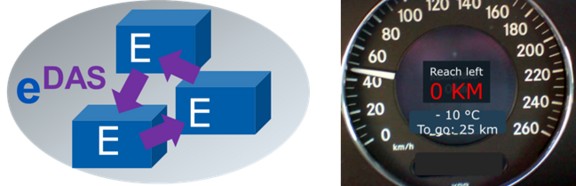
eDAS stands for efficiency powered by smart Design, meaningful Architecture and connected Systems.
As part of a collaboration with the ‘iCompose’ and “Incobat” projects, the ‘eDAS’ project aims to research a technical solution for increasing the range and reliably predicting the remaining range of third- and fourth-generation electric vehicles. The “eDAS” project has been running since 1 October 2013 and will last for 36 months. It was proposed to the European Union and approved by a consortium of 15 European partners from research and industry.
The main focus of the project lies in the networking and intelligent use of the various energy sources within an electric vehicle. The individual partners are supplying hardware and software components which, together, are intended to increase the range of a future electric vehicle and improve the quality of range prediction. In developing the necessary interfaces, the project is collaborating with the “iCompose” and “Incobat” projects to utilise a common hardware and software platform, thereby reducing the subsequent effort required for system integration.
OTH Amberg-Weiden’s remit lies in the development of software modules to be deployed on the vehicle’s central control unit. The focus is on developing an Energy Resource Scheduler (ERS), which forms a software layer of the Energy Management System (EMS). Together with the hardware to be developed, as well as the application layers of the controller software, the aim is to establish a system for intelligent, route- and usage-dependent energy management within the vehicle.
Prof. Dr Höß is responsible for the project at OTH Amberg-Weiden. The work is being carried out by Ms Lepke and Mr Waigel.
ENIAC-Projekt „MotorBrain“

The project was submitted to ENIAC in July 2010 by a consortium of around 30 European partners. The project was approved in spring 2011 and has been running since 1 July 2011. It aims to develop a fully electric powertrain for use in cars.
The particular challenges of the project lie in the development of novel, energy-efficient components and the control of their interaction to ensure high safety standards. Future electric vehicles must remain functional even if some faults occur and must at least allow the vehicle to be safely moved out of the traffic zone. The focus of the research is shifting from the level of individual components towards the overall integration of subsystems into a fail-safe, reliable and highly efficient drive system.
The tasks of OTH Amberg-Weiden in this context involve software development for an automotive control unit from Infineon, focusing on signal acquisition and processing from sensors in the rotor of a completely new electric motor, the skilful use of redundancies, and the integration of partner software modules on this platform in collaboration with the respective partners. The project is primarily led by Ms Lepke and supervised by Prof. Höß.
HAVEit

The Faculty of Electrical Engineering, Media and Computer Science is engaged in applied research into driver assistance systems as part of the HAVEit (Highly Automated Vehicles for Intelligent Transport) research project under the EU’s 7th Framework Programme (FP7). Eighteen leading companies and research institutions are setting up seven test vehicles (four cars and three lorries) as part of HAVEit. The project is divided into two areas: ‘Highly automated driving’ and ‘Safety architecture applications’.
The main task of the EMI Faculty is the development and implementation of algorithms for a network of radar sensors to monitor the vehicle’s side and rear areas within the ‘Automated Roadwork Assistance’ sub-project. The aim of this application is to provide highly automated support to the driver in stressful situations, particularly when passing through roadworks on motorways. Specific challenges here include, for example, narrow lanes, unclear road markings, changing speed limits or other vehicles travelling close by.
KI-ASIC

The KI-ASIC project aims to transfer neuromorphic electronics from fundamental academic research into automotive applications and provide solutions to the key challenges of autonomous driving. The project thus makes an important contribution to boosting the innovative strength of the German automotive industry and Germany as a business location.
Objectives of the KI-ASIC project:
- Use of neuromorphic processor architectures for radar processing utilising Deep Neural Networks (DNN) and Spiking Neural Networks (SNN)
- Acquisition, processing and evaluation of radar signals as a data basis for the development of AI-supported neuromorphic processor architectures
- Reduction of the energy balance for radar sensors
- First application of neuromorphic processors (SpiNNaker 2) in the automotive sector
- Gaining knowledge in the field of coding and application of SNNs
KO-HAF

The Ko-HAF research project (an acronym for: Cooperative Highly Automated Driving) at the East Bavarian University of Applied Sciences Amberg-Weiden (OTH-AW) aims to take the next steps towards highly automated driving at higher speeds. The main objective is to increase a vehicle’s detection range. To this end, sensor data from many automated vehicles is fused and aggregated via a safety server. This requires establishing communication via the mobile network.
To guarantee reliable data transmission, it is important to continuously monitor the communication. Appropriate software must be developed for this purpose. This thesis presents various approaches for passively monitoring a network. The thesis begins by presenting various algorithms for determining quality parameters such as round-trip time and throughput of a connection. It then demonstrates how various mobile network-related data can be collected. Finally, the thesis outlines various use cases for significantly improving automated driving using this data.
UR:BAN

Urban areas: User-friendly assistance systems and network management
Due to the constant increase in the number of vehicles worldwide, traffic density on roads and motorways is constantly rising. Whilst approximately 38 million passenger cars were manufactured worldwide in 1998, this figure had almost doubled to nearly 68 million by 2014. This brings with it increasing demands on road users’ ability to concentrate and react. Many drivers are often distracted or overwhelmed by the sheer volume of information. [Wai15]
To meet today’s challenges in increasingly dense traffic, vehicle manufacturers are fitting more and more vehicles with driver assistance and safety systems as standard. These systems are designed to relieve the driver and ensure that the driver can concentrate on their essential tasks. Despite the rising number of accidents, a clear trend towards fewer and fewer road deaths can be observed due to the higher safety standards of vehicles. [Wai15]
Urban areas in particular present many challenges, as high traffic density meets limited space in the traffic environment. The research project Urban Space: User-Oriented Assistance Systems and Network Management (UR:BAN) is investigating new solutions for this traffic environment. [Wai15]
In this project, OTH Amberg-Weiden is working alongside 30 partners from industry and research as a subcontractor for Continental Teves AG & Co. oHG on radar sensor technology that has been modified for use in urban scenarios. The team at the Automotive Engineering project office led by Prof. Dr Alfred Höß is working on characterising the new sensors and, on behalf of Continental Teves AG & Co. oHG, is primarily engaged in the analysis of measured bottlenecks and parking scenarios. To this end, the project has developed its own measurement equipment and programmed analysis algorithms. The research contract of OTH Amberg-Weiden within the UR:BAN project ends with the calendar year 2015.
Source:
[Wai15] A. Waigel, Analysis and Evaluation of a W-Band Radar Sensor in Short-Range Applications for the Urban Environment, Master’s thesis, East Bavarian Technical University of Applied Sciences Amberg-Weiden, Amberg, June 2015
Prystine

Dynamically adapted, reliable mobile communications for automated driving
Vehicles with automation levels 3–5 and fault-tolerant all-round perception, measurement and prediction of mobile network quality whilst driving, and evaluation of mobile data connections.
At higher levels of automation (Level 4 and, in particular, Level 5), the driver is not available as a fallback option, meaning that the automation system must be capable of handling safety-critical situations independently. At these levels of automation, fault tolerance is crucial throughout the entire automation chain, from sensing and planning right through to execution. This is precisely where PRYSTINE comes in: PRYSTINE aims to realise a fault-tolerant all-round perception system (Fail-operational Urban Surround perceptION, FUSION) for automation levels 3–5, based on robust radar and lidar sensor fusion. The control functions to be developed in the project are intended to enable safe automated driving in urban environments as well as on rural roads.
Prystine’s objectives:
- Vehicles with automation levels 3–5 and fault-tolerant all-round perception for both urban and rural environments.
- Measurement and prediction of mobile network quality whilst driving.
- Evaluation of mobile data connections.
- Reduction of latency in mobile network-based communication for automated driving in rural environments.
- Robust C-V2X communication for safe automated driving.
The sub-project at OTH Amberg-Weiden aims to ensure the highest possible transmission speed, with maximum reliability and security of the mobile connection between the backend and the vehicle, depending on the quality of the mobile connection.
Thanks to its wide range of research topics, the Automotive Team also offers opportunities for Master’s and Bachelor’s theses in the fields of highly automated driving, sensor data processing, AI algorithms and software development.