


Mastering your studies successfully, going your own path and experiencing individual support – we want to make this possible for all students of our university. Together with students and teaching staff we develop customised offers for this.
In line with this vision, we create and operate in the Competence Centre for Fundamental Subjects (Kompetenzzentrum Grundlagen, CCG) which is reflected in our goals and our university-wide, student-centred and evidence-based architecture.
Our goals
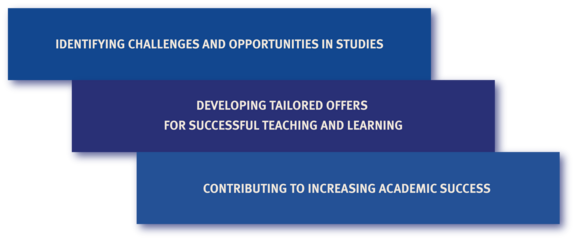
Primary target groups of our offers are students of all courses involving mathematics or computer science in their first semesters as well as teaching staff as active designers of the learning environment and contact persons for students.
We think holistic and include relevant groups from all faculties and institutions in the development and improvement of our offers.
Evidence-based approaches and scientifically sound evaluation of the efficacy of the various offers allows us to create sustainable, attractive and needs-based framing conditions for succesessful teaching and learning processes and support a continous skill development of students and teachers at the same time.
Would you like to work with us?
Please contact us by mail or telephone. We look forward to hearing from you!
Overview of our current points of focus
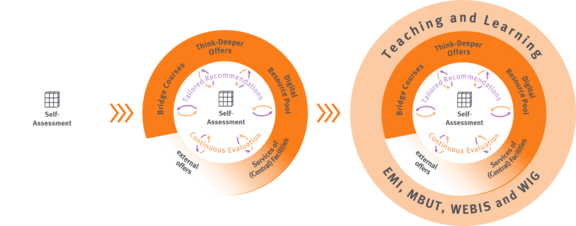
We capture, generate and develop support activities harmonious in a university-wide portfolio and implement these in cooperation with other central facilities. In the student-life-cycle we address university-wide mainly the transition from school and/or job to university and following from this the initial phase of study (typically semester 1 to 3) from a professional point of view. In this way, we as a university support students according to their individual prerequisites and competences. Our operative focuses are currently divided into three areas of work:
We prepare students for the mathematical requirements of their studies by offering a bridge course in mathematics prior to the start of their studies. Our Bridge Course working group is working together with lecturers on optimising and expanding the range of courses on offer, for example to include bridge courses during the semester, offers for computer science, as well as taking into account the increasing internationalisation of our university.
Here you can find our preparation offers.
We collect (digital and analogue) (exercise) tasks and categorise them according to a taxonomy adapted to the specific requirements of higher education. That is how we create a structered collection of questions in the Digital Ressource Pool for lecturers in the basic subjects. In this way, we are making a long-term contribution to further improving the quality of teaching and help make the use of digital ressources efficient and attractive.
In this working group we collaborate with other universities and internally with the Service Centre for Digital Exercises.
In the working group Think Deeper we design support offers for the fundamental phase needs-based and implement them. A particular focus for us is to help students to help themself and strengthen the sense of belonging to our university. Current examples for specific measures in a planning or testing phase are
- the design of a university-wide tutoring program combined with a mentoring program
- the Digital Helpdesk Mathematics
In addition to the involvement of all four faculties of the OTH Amberg-Weiden through the collaboration of teaching staff in the Competence Centre for Fundamental Subjects and subject-specific cross-faculty exchange meetings with teaching staff, it is important to us to include both students as well as central facilites in all areas. Currently, we achieve this through meetings with student councils and representatives and regular exchange with central facilites.
Subject areas
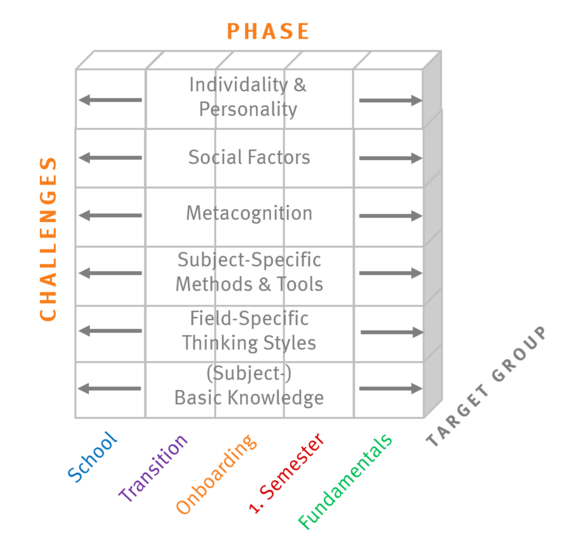
While settling in at the university students are typically confronted with a variety of complex topics. The interaction of the various factors is very individual. To keep an overview of this and corresponding support services or the need for such, we categorise challenges and potentials in six key areas and relate them to the phases of the student-life-cycles that are particularly relevant for us.
The cube below shows the dimensions in which we categorise existing and future support offers: Challenges/potentials, phase of study and target group. This illustration makes it easy to see, which offers are available for which needs and it also enables us to see, where new services need to be developed.
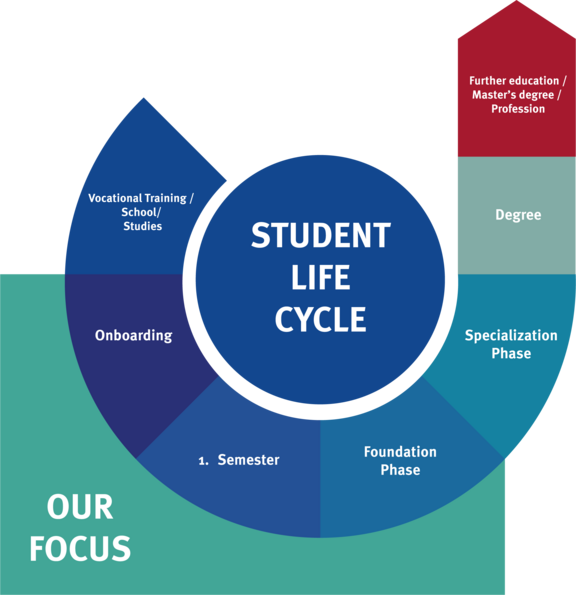
Together with the existing measures of central facilities emerges a network of support offers for students over the entire student-life-cycle. This allows us in cooperation with advisory services of the university, faculties and degree programs to recommend individual measures after conducting a needs analysis.
University-wide – student-centred – evidence-based
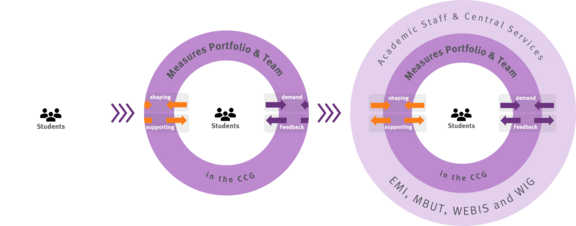
The Competence Centre for Fundamental Subjects follows a univsersity-wide and student-centred approach. Students are supported with the help of customised recommendations according to their individual prerequisites and competences. Teaching personnel can access tried and tested learning ressources, which considers the different needs or prerequisites of students. As key target groups, students and teachers benefit from the portfolio of measures and actively participate in its development.
Collaboration & communication
Content & process