
References
2024
Development of innovative task templates for the automated verification of textual answers in medical engineering
Project duration: From 12/2024
Client: Prof. Dr. Matthias Feyrer
Faculty: WIG
A task has been created that allows for the verification of a list of specific criteria present in a text entered by students. Further useful verification scenarios are currently being developed experimentally. The task types are intended to be used in future digital exams.
Development of a task package for synchronous machines for the lecture on Electrical Machines and Drives
Project duration: From 12/2024
Client: Prof. Dr. Heiko Zatocil
Faculty: EMI
In the first step of this project, model solutions will be integrated for all previously created tasks. In the second step, a task package on the topic of synchronous machines will be developed using a proven development process. An already developed drawing tool for the current locus curve will be used, while a new tool for phasor diagrams will be developed.
Consultation and support in digital task development and the setup of a digital exam for Python programming
Project duration: 10/2024 - 01/2025
Client: Prof. Dr. Thomas Nierhoff
Faculty: EMI
Meetings were held to explain the development of CodeRunner tasks. Additionally, a development environment was set up, populated with examples, and specific templates were created for the professor, tailored to meet individual requirements. Subsequently, the tasks were fully developed by the professor, with support provided through various assistance activities. Following this, the concept for the digital exam was collaboratively designed and technically prepared by the Service Centre, with support provided up to the correction phase.
Gamification of a Computer Science course and development of a digital mock exam with STACK
Project duration: 09/2024 - 01/2025
Client: Prof. Dr. Michael Wiehl
Faculty: EMI
The Moodle course space for the Computer Science (Fundamentals) course in the AI/IK degree programmes was gamified. The entire course was given a new theme, in this case, that of retro role-playing games. With every use of course materials, participants earn experience points, tracked by the "Level up!+" plugin. This allows their own character to level up from a simple peasant to a shining hero. The Moodle quizzes are considered "enemies" to be defeated in order to unlock the next course content and, consequently, the slide sets for the upcoming session. The course overview is provided by a learning map, created with the "Learning Map" plugin, where all slide sets and quizzes are marked as locations. What is initially shrouded in mist is gradually "unlocked", and ultimately, the path leads to the "final boss", the mock exam. This was implemented as a Moodle quiz with several STACK tasks. For successful completion, meaning achieving at least 50% of the points, students receive the complete solution to the mock exam along with useful tips and hints for the actual exam.
Implementation of randomised tasks with automatic model solutions in technical fluid mechanics
Project duration: From 06/2024
Client: Prof. Dr. Olaf Bleibaum
Faculty: MBUT
Existing tasks with static model solutions will be converted into randomised digital tasks with automatic model solutions. Special attention will be given to error tolerance, subsequent errors, and the awarding of partial points in order to reduce the impact of small calculation mistakes.
Support with the migration of Python tasks to Moodle
Project duration: From 06/2024
Client: Prof. Dr. Christian Schieder
Faculty: WEBIS
The Service Centre provides support and advice in converting existing open-source Python exercise code into CodeRunner tasks that can be used in Moodle. To date, suggestions for course design in Moodle have been made, along with initial options for test implementation and test display in CodeRunner. The project is expected to continue in 2025.
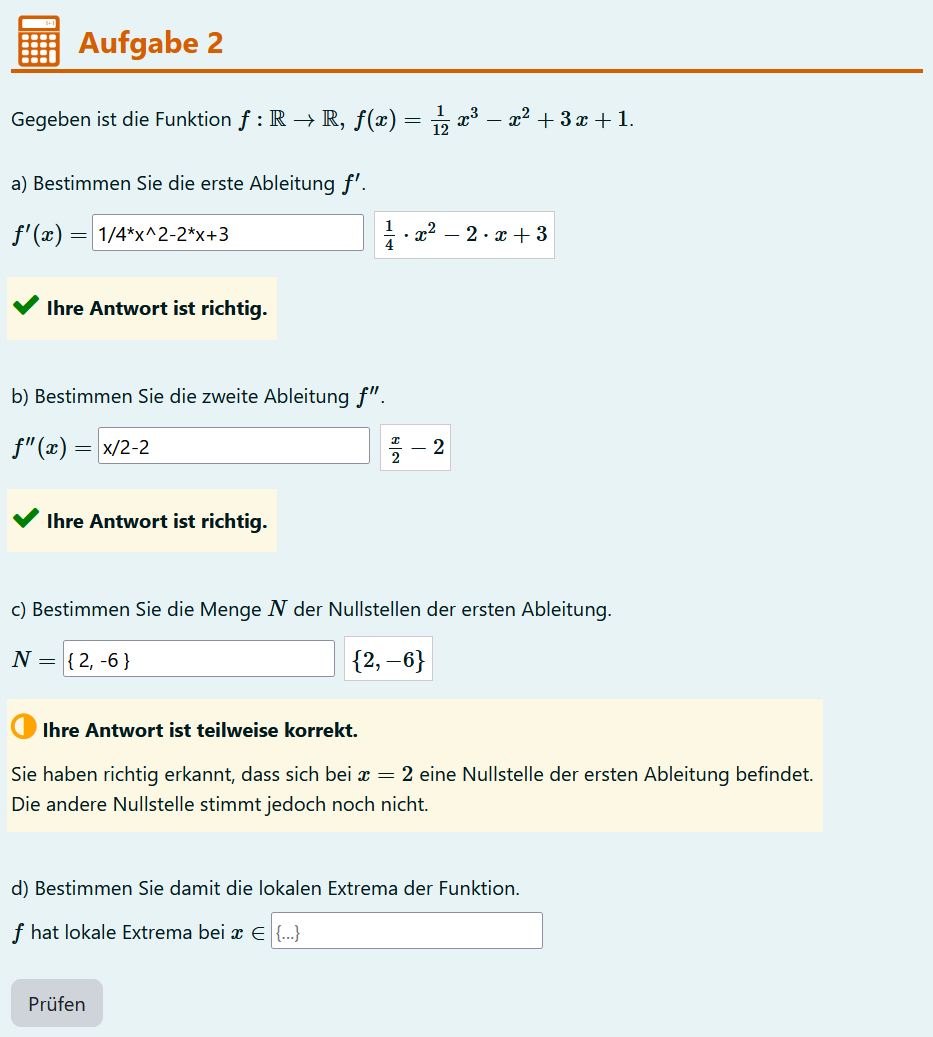
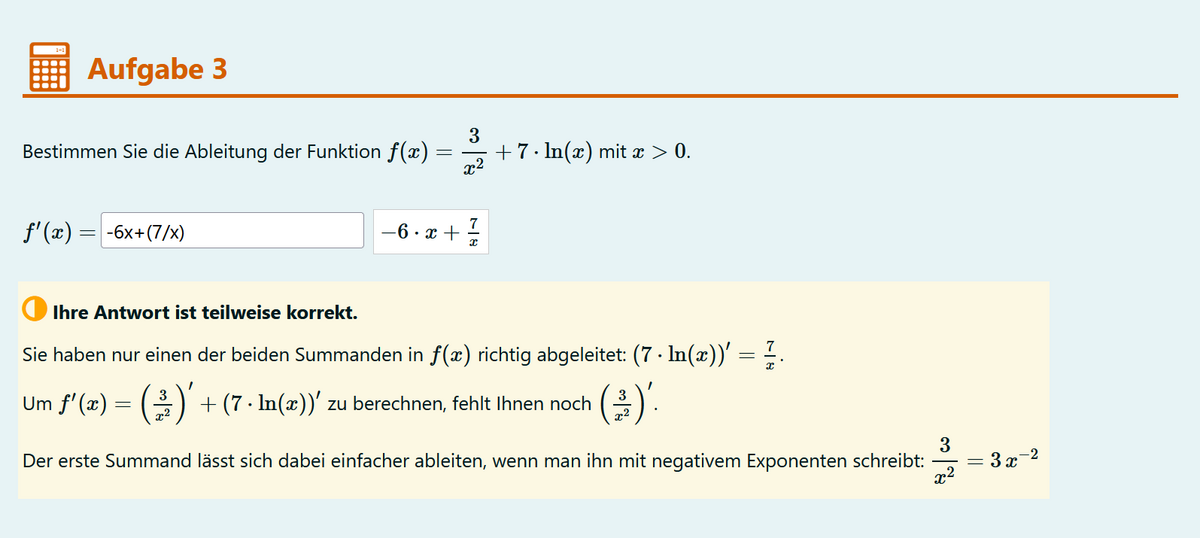
Further development of the learning module on Differential and Integral Calculus
Project duration: 05/2024 - 03/2025
Client: Prof. Dr. Harald Schmid, Prof. Robert Queitsch
Faculty: MBUT
After the initial use of the learning module at the start of the summer semester 2024 for approximately 100 students, the following developments were decided based on the evaluation, which will be implemented by the Service Centre for Digital Assignments:
- Inclusion of previously unconsidered error cases and development of tailored feedback based on the actual inputs from students
- Implementation of additional tasks on integral calculus
- Simplification of interval input in the final test
- Integration of a central formula collection, which can be referenced in tasks