
References
Statistics
30%
of the University's teaching staff use the Service Centre
50% / 50%
of Service Centre users are based at the Amberg and Weiden campuses
35% / 15% / 37% / 13%
of Service Centre users are distributed across the EMI / MBUT / WEBIS / WIG faculties
72% / 23% / 5%
of requests by teaching staff are about STACK / CodeRunner / other question types
2026
Implementation and Testing of Digital Examination Questions in Statistics
Project period: 07/2026
Client: Prof. Dr. phil. Stefan Uebelacker
The Service Centre for Digital Exercises supported the implementation of STACK questions based on the lecturer’s specifications for a statistics examination and carried out technical and functional testing of additional examination questions. The examinations were conducted in the OTH Amberg-Weiden examination Moodle environment.
Implementation and Testing of Digital Examination Questions in Finance and Investment Management
Project period: 06/2026 – 07/2026
Client: Prof. Dr. Julia Kreppmeier
Faculty: WEBIS
A multi-part STACK question for use in Finance and Investment Management was implemented based on the lecturer’s concept. In addition, the STACK questions of two examinations were technically reviewed and tested for functionality. Technical support was subsequently provided during the post-examination marking process. The examinations were conducted in the OTH Amberg-Weiden examination Moodle environment.
English Translation of the Learning Module "Complex Numbers"
Project period: since 06/2026
Client: Centre of Competence for Foundation Studies (CCG)
The Complex Numbers learning module offered by the Centre of Competence for Foundation Studies is being translated into English and adapted for bilingual use so that international students can also benefit from the resource. To achieve this, the included interactive videos, slideshows and digital tasks are being automatically pre-translated using various technical approaches, including an offline AI-based transcription tool. The translations are subsequently subject to academic review by the Centre of Competence for Foundation Studies.
Consultancy and Support for the Delivery of Digital Examinations in the International Business Degree Programme
Project period: 06/2026 – 07/2026
Client: M.A. Cornelia Oszlonyai
Faculty: WEBIS
Digital examinations in the modules Business Mathematics, Business Statistics and Principles of Economics were conducted for the first time in the examination Moodle environment. The Service Centre for Digital Exercises supported the adaptation of STACK questions as well as the setup and delivery of the examinations, which were held across multiple time slots.
Coordination of Bug Fixes in CodeRunner Questions Following a Learning Platform Update
Project period: 06/2026 – 07/2026
Client: Prof. Dr. Thomas Nierhoff, Prof. Dr. Dieter Meiller
Faculty: EMI
After the installation of specific libraries had been enabled in 2025 to enhance CodeRunner questions in web development, issues emerged following a learning platform update in 2026. The Service Centre documented the lecturers’ issue reports, analysed them professionally and coordinated timely solutions in cooperation with the university IT services.
Repair of Mock Examination Questions in Economics
Project period: 06/2026
Client: Prof. Dr. Horst Rottmann
Faculty: WEBIS
Due to a temporary error following a learning platform update, two STACK questions were converted into cloze-type questions and integrated to enable the short-notice delivery of a mock examination. To maintain consistency, the numerical format was aligned with the examination questions.
Adaptation of Researched Digital Questions and Delivery of Computer Lab Tests in Mathematics
Project period: 03/2026 – 07/2026
Client: Prof. Dr. Nada Sissouno
Faculty: EMI
Selected STACK questions from the digital Mathematics question bank of the Centre of Competence for Foundation Studies (CCG) were adapted to meet the requirements of the course. This included revising question wording, notation, input formats, automatic assessments and model solutions. To prepare students, a syntax test and a voluntary practice test were set up.
Support for the Delivery and Adaptation of BYOD Tests in Computer Science
Project period: 03/2026 – 06/2026
Client: Prof. Dr. Sandra Rebholz, Prof. Dr. Alexander Prinz
Faculty: EMI
The Service Centre revised several CodeRunner questions with regard to the conditional display of test cases and their differentiated assessment. Findings from previous marking processes were incorporated into the automated assessment, and additional examination options, such as the conditional display of test cases, were further optimised.
Implementation and Verification of Digital Questions for the International Business Admission Test
Project period: 03/2026 – 04/2026
Client: Lecturers of the International Business degree programme
Faculty: WEBIS
For a digital admission test, several question concepts provided by lecturers were implemented as randomised STACK questions by the Service Centre. To ensure efficient and robust implementation of structurally similar questions, a Python-based templating solution was developed, requiring only the differing elements of each question to be entered. This ensured a consistent structure across all questions.
Support for the Delivery of a Computer Lab Test in Mathematics
Project period: 03/2026 – 04/2026
Client: Prof. Dr. Harald Schmid
Faculty: MBUT
The Service Centre supported the setup and delivery of the final assessment within the learning module “Differential and Integral Calculus” as part of a mathematics course.
Technical Integration of the Digital Electrical Engineering Question Bank into a Lecture Course
Project period: 03/2026
Client: Prof. Dr. Hubert Rubenbauer
Faculty: EMI
The Digital Electrical Engineering Question Bank was transferred to and configured within the lecture’s Moodle course.
Development of CodeRunner Questions for Weekly Exercises in C Programming
Project period: 01/2026 – 04/2026
Client: Prof. Dr. Peter Raab
Faculty: EMI
Based on a series of exercise sheets, the Service Centre developed suitable CodeRunner questions for use throughout the semester. Multiple test cases were designed and integrated for each question.
2025
Support for the Setup and Delivery of BYOD Tests
Project period: 11/2025 – 12/2025
Clients: Prof. Dr. Alexander Prinz, Prof. Dr. Sandra Rebholz
Faculty: EMI
The Service Centre reviewed the configuration of two BYOD tests, made minor adjustments to CodeRunner questions, and provided support during the delivery of the tests.
Translation of WIRIS Questions into STACK Questions
Project period: 07/2025 – 09/2025
Clients: Prof. Dr.-Ing. Abels-Schlosser, Prof. Dr. Christoph Pitzl
Faculty: WEBIS
The Service Centre translated a number of WIRIS questions into STACK questions. As part of this process, the code used for question configuration in WIRIS was ported to Maxima, the computer algebra system used by STACK.
Integration of a Learning Module into a Mathematics Course
Project period: 05/2025 – 06/2025
Client: Prof. Dr. Nada Sissouno
Faculty: EMI
The Service Centre integrated a chapter of the Linear Algebra learning module into the Moodle course of a mathematics module.
Provision of a Guide for Adapting Safe Exam Browser Configuration Files
Project period: 04/2025 – 09/2025
Client: Prof. Dr. Christian Stauf
Faculty: WEBIS
The Service Centre produced a guidance document explaining how to adapt Safe Exam Browser (SEB) configuration files for environments in which certain software applications prevent SEB from launching successfully.
Implementation of a Study Entry Assessment Covering Subject-Specific and Transferable Skills Using STACK
Project period: 04/2025 – 09/2025
Client: Centre of Competence for Foundation Studies (CCG)
The Service Centre developed templates for the implementation of bilingual and randomised STACK questions for both the subject-specific and transferable-skills sections of the assessment. In addition, the assessment feedback was incorporated, and students were provided with the option to download their individual feedback.
Adaptation of Admission Test Questions for an International Master's Degree Programme
Project period: 02/2025 – 09/2025
Client: Prof. Dr. Michael Wiehl
Faculty: EMI
The Service Centre adapted several questions in the admission test for the international Master's degree programme MAI to make them more robust against the use of AI chatbots. For example, interactive elements based on the JSXGraph library were incorporated to prevent the generation of immediate solutions from screenshots.
Implementation of three digital examinations for the modules Business Mathematics, Business Statistics and Principles of Economics
Project duration: 02/2025 - 07/2025
Client: M.A. Cornelia Oszlonyai
Faculty: WEBIS
The starting point was approximately 60 paper-based examination tasks in the modules Business Mathematics, Business Statistics and Principles of Economics. The digital implementation of all examination tasks, as well as the setup and delivery of three digital examinations in the summer semester of 2025, was successfully completed. Technical support was subsequently provided during the post-examination marking process.
Development and integration of a self-study unit for the Laplace transformation into the Control Engineering lecture
Project duration: 01/2025 – 02/2026
Client: Prof. Dr.-Ing. Bernhard Frenzel, Prof. Dr.-Ing. Armin Wolfram
Faculty: MBUT
This project resulted in a gamified self-study unit with interactive videos and digital tasks, which were integrated into an existing inverted classroom concept at the beginning of the Control Engineering lecture. The Service Centre for Digital Assignments was responsible for the gamification of the self-study unit as well as the implementation of the included STACK tasks and interactive graphs.
Implementation of digital tasks for web development in HTML/CSS/JavaScript
Project duration: 01/2025 - 05/2025
Client: Prof. Dr. Thomas Nierhoff, Prof. Dr. Dieter Meiller
Faculty: EMI
A coordinated development process for CodeRunner tasks for web development courses was planned. Professors teaching the same content were identified, in this case in the field of web development. Initially, prototype examples for the automated assessment of HTML, CSS and JavaScript were created in order to establish technical and pedagogical approaches for the development of further tasks. The prototypes were used by two professors in different courses for examinations and mock examinations and were subsequently further developed independently. The installation of the required libraries was coordinated by the Service Centre and carried out by the Computing Centre.
Implementation of digital tasks for the fundamentals of C programming
Project duration: 01/2025 - 04/2025
Client: Prof. Dr. Peter Raab
Faculty: EMI
It was agreed that exercise tasks would be implemented based on existing worksheets. Two worksheets were successfully implemented and trialled. The majority of the tasks were created using CodeRunner. Most of the implementation effort was devoted to the design and pedagogical preparation of meaningful test cases.
Implementation of STACK tasks for a digital examination in Finance and Investment Management
Project duration: 01/2025
Client: Prof. Dr. Julia Kreppmeier
Faculty: WEBIS
Based on a detailed design document provided by the lecturer, two new STACK tasks were implemented. The multi-part tasks are fully randomised and combine various input types. Particular emphasis was placed on clear input instructions, tolerance during automated assessment, and especially comprehensive testing to ensure correctness.
Review of STACK tasks prior to a digital examination in Macroeconomics
Project duration: 01/2025
Client: Prof. Dr. Thorsten Hock
Faculty: WEBIS
Prior to a digital examination, several STACK tasks were reviewed by the Service Centre for Digital Assignments for technical robustness, including the addition and execution of automated question tests covering all randomised variants.
2024
Development of innovative task templates for the automated verification of textual answers in medical engineering
Project duration: From 12/2024
Client: Prof. Dr. Matthias Feyrer
Faculty: WIG
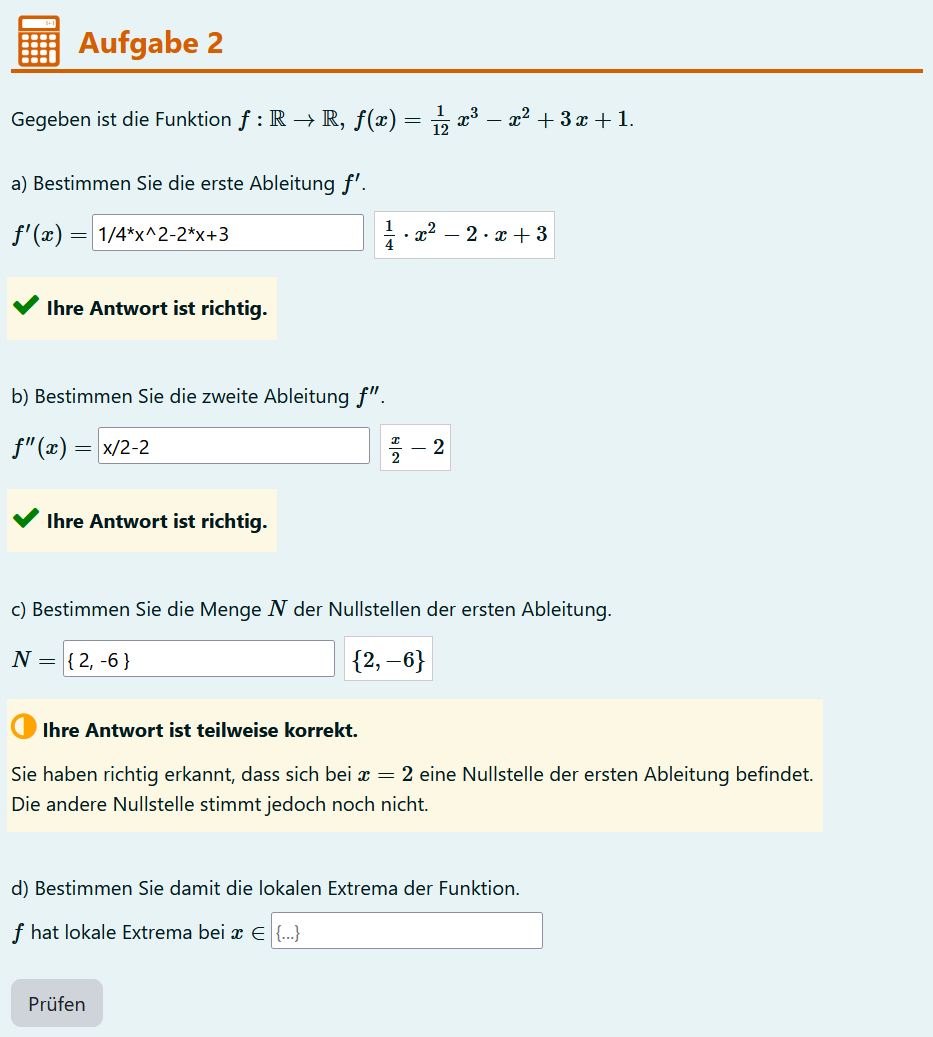
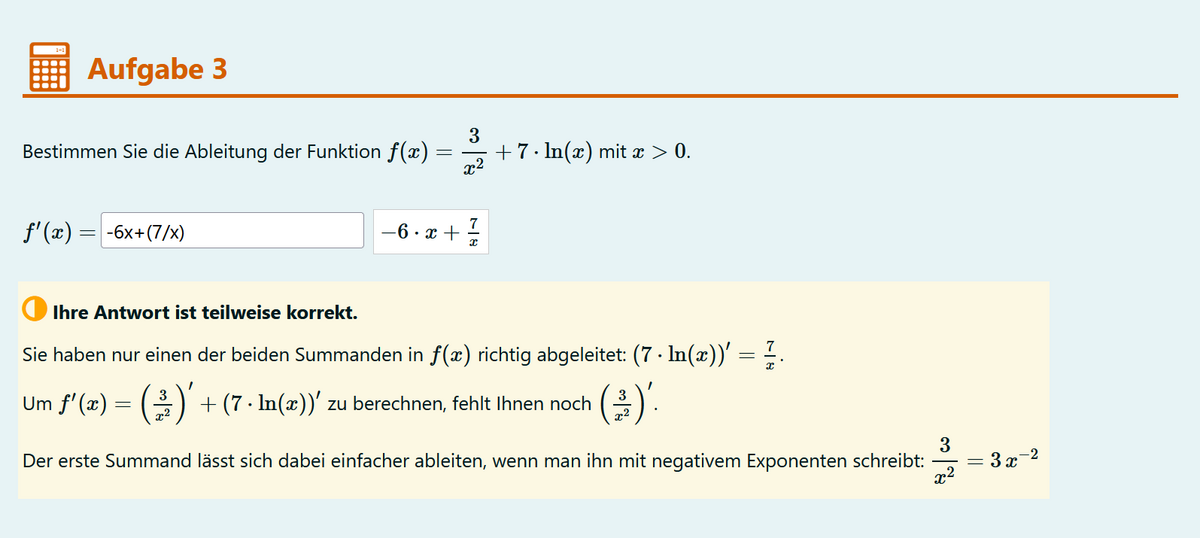
A task has been created that allows for the verification of a list of specific criteria present in a text entered by students. Further useful verification scenarios are currently being developed experimentally. The task types are intended to be used in future digital exams.
Development of a task package for synchronous machines for the lecture on Electrical Machines and Drives
Project duration: From 12/2024
Client: Prof. Dr. Heiko Zatocil
Faculty: EMI
In the first step of this project, model solutions will be integrated for all previously created tasks. In the second step, a task package on the topic of synchronous machines will be developed using a proven development process. An already developed drawing tool for the current locus curve will be used, while a new tool for phasor diagrams will be developed.
Consultation and support in digital task development and the setup of a digital exam for Python programming
Project duration: 10/2024 - 01/2025
Client: Prof. Dr. Thomas Nierhoff
Faculty: EMI
Meetings were held to explain the development of CodeRunner tasks. Additionally, a development environment was set up, populated with examples, and specific templates were created for the professor, tailored to meet individual requirements. Subsequently, the tasks were fully developed by the professor, with support provided through various assistance activities. Following this, the concept for the digital exam was collaboratively designed and technically prepared by the Service Centre, with support provided up to the correction phase.
Gamification of a Computer Science course and development of a digital mock exam with STACK
Project duration: 09/2024 - 01/2025
Client: Prof. Dr. Michael Wiehl
Faculty: EMI
The Moodle course space for the Computer Science (Fundamentals) course in the AI/IK degree programmes was gamified. The entire course was given a new theme, in this case, that of retro role-playing games. With every use of course materials, participants earn experience points, tracked by the "Level up!+" plugin. This allows their own character to level up from a simple peasant to a shining hero. The Moodle quizzes are considered "enemies" to be defeated in order to unlock the next course content and, consequently, the slide sets for the upcoming session. The course overview is provided by a learning map, created with the "Learning Map" plugin, where all slide sets and quizzes are marked as locations. What is initially shrouded in mist is gradually "unlocked", and ultimately, the path leads to the "final boss", the mock exam. This was implemented as a Moodle quiz with several STACK tasks. For successful completion, meaning achieving at least 50% of the points, students receive the complete solution to the mock exam along with useful tips and hints for the actual exam.
Implementation of randomised tasks with automatic model solutions in technical fluid mechanics
Project duration: From 06/2024
Client: Prof. Dr. Olaf Bleibaum
Faculty: MBUT
Existing tasks with static model solutions will be converted into randomised digital tasks with automatic model solutions. Special attention will be given to error tolerance, subsequent errors, and the awarding of partial points in order to reduce the impact of small calculation mistakes.
Support with the migration of Python tasks to Moodle
Project duration: From 06/2024
Client: Prof. Dr. Christian Schieder
Faculty: WEBIS
The Service Centre provides support and advice in converting existing open-source Python exercise code into CodeRunner tasks that can be used in Moodle. To date, suggestions for course design in Moodle have been made, along with initial options for test implementation and test display in CodeRunner. The project is expected to continue in 2025.
Further development of the learning module on Differential and Integral Calculus
Project duration: 05/2024 - 03/2025
Client: Prof. Dr. Harald Schmid, Prof. Robert Queitsch
Faculty: MBUT
After the initial use of the learning module at the start of the summer semester 2024 for approximately 100 students, the following developments were decided based on the evaluation, which will be implemented by the Service Centre for Digital Assignments:
- Inclusion of previously unconsidered error cases and development of tailored feedback based on the actual inputs from students
- Implementation of additional tasks on integral calculus
- Simplification of interval input in the final test
- Integration of a central formula collection, which can be referenced in tasks
Development of STACK tasks on inverter converters
Project duration: From 05/2024 – 10/2024
Client: Prof. Dr. Heiko Zatocil
Faculty: EMI
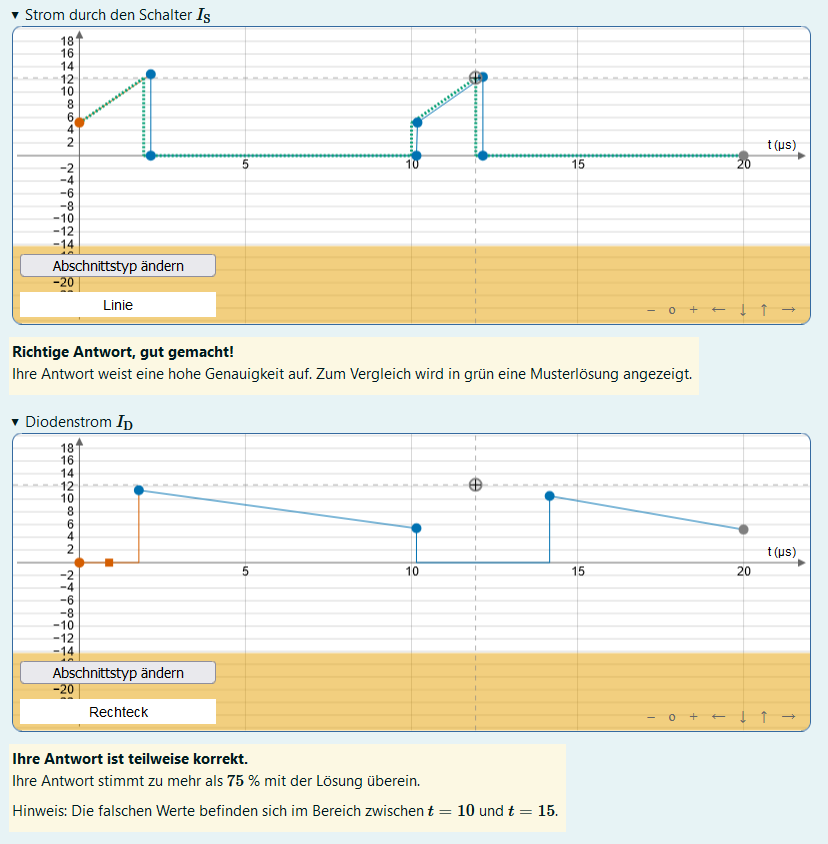
The planned work involves integrating the voltage waveform drawing tool developed by the Service Centre for Digital Assignments into a task on inverter converters. Following its integration with randomisation and feedback functionality, further variants of the task will be developed. To promote reusability and efficient task development, the various task versions will use the same calculation logic while providing and requesting different values.
Digital examination in the IoT Technology module
Project duration: 04/2024 - 01/2025
Client: Prof. Dr. Kris Dalm
Faculty: WIG
In the IoT Technology module, the examination has previously been conducted in a format that requires a very high marking effort. To address this, the Service Centre for Digital Assignments provides support through the following measures:
- Development of CodeRunner tasks in the C programming language
- Support in creating a digital examination
Implementation of exercises and compulsory assignments in the Programming Starter module and support in the use of the Safe Exam Browser
Project duration: 04/2024 - 06/2024
Client: Prof. Dr. Sandra Rebholz, Prof. Dr. Christian Bergler
Faculty: EMI
The bilingual international module “Programming Starter” introduces the fundamental concepts of a programming language using Python as an example. It is taught in a hybrid format and attended by both bachelor's and master's students in the field of Artificial Intelligence. Given this heterogeneous starting point, the Service Centre for Digital Assignments primarily supports the implementation of formative and summative assessments:
- Implementation of approximately 30 exercise tasks and around 10 examination tasks using CodeRunner and provision within online tests running throughout the semester (3 exercise tests and 3 examination tests)
- Development and integration of numerous test cases to provide error-specific feedback and ensure fair assessment
- Support for the use of the Safe Exam Browser in Moodle through the creation of appropriate configuration files for both online and on-campus participants, as well as the preparation of corresponding guidance for lecturers and students
Automatic assessment of laboratory exercises in the Electrical Engineering and Cyber-Physical Systems module
Project duration: 02/2024 - 07/2024
Client: Prof. Dr. Michael Wiehl
Faculty: EMI
In the Electrical Engineering and Cyber-Physical Systems module, the digital laboratory notebook from the Cyber-Physical Systems 1 module was used as the starting point.
Fundamental adaptations were made and student feedback was also incorporated.
The Service Centre for Digital Assignments was responsible for implementing the following elements:
- Creation of additional CodeRunner tasks
- Enhancement of the existing CodeRunner tasks through further randomisation and additional test cases in order to make assessment even fairer and further reduce the effort required for post-examination marking
- Extension of the library used to integrate the sensor language into CodeRunner
Restructuring of the semester-long online tests for the Business Information Systems Electrical Engineering module
Project duration: 02/2024 - 05/2024
Client: Prof. Dr.-Ing. Manfred Beham
Faculty: WIG
The initial 21 semester-long tests were to be reduced in both number and scope. The Service Centre for Digital Assignments developed a proposal consisting of 11 tests, each with a reduced number of tasks. The designated tasks were assigned to the tests, allocated marks and reviewed for robustness. New STACK functionalities were used to implement small improvements to usability.
Further revision of the aptitude test for the Artificial Intelligence for Industrial Applications (MAI) master's programme
Project duration: 01/2024 - 06/2024
Client: Prof. Dr. Michael Wiehl
Faculty: EMI
Following the positive experiences with the admission process for the winter semester 2023/2024 and the summer semester 2024 for the Artificial Intelligence for Industrial Applications master's programme, the aptitude test was continued in the following semester. Experiences gained from previous semesters were incorporated into the revised version.
The Service Centre for Digital Assignments was responsible for implementing the following elements:
- Revision of the preliminary test based on responses from the previous semester
- Modification and extension of the aptitude test randomisation
- Technical support during the test sessions
Integration of a Linear Algebra learning module into the Mathematics for Engineers II course
Project duration: 01/2024 - 06/2024
Client: Prof. Dr. Harald Schmid
Faculty: MBUT
The Linear Algebra learning module teaches the fundamentals of matrices, systems of equations and determinants using a variety of components, including instructional videos, animations, textual content, H5P presentations, interactive graphs and tasks. Based on an existing concept and taking into account continuous subject-specific feedback, the Service Centre for Digital Assignments implemented the following elements:
- 1 syntax test containing 5 STACK tasks on the input of mathematical expressions
- 50 STACK tasks covering the content of the individual chapters
- 3 randomised examination tasks
- A wide range of interactive applets embedded in tasks, texts, slides and on the course interface
2023
Revision of the Complex Numbers learning module
Project duration: 10/2023 - 02/2025
Client: Prof. Dr. Harald Schmid, Prof. Robert Queitsch
Faculty: MBUT
The Complex Numbers learning module teaches the fundamentals of complex numbers across five chapters, including topics such as the complex plane, Euler's formula and the nth roots of a complex number. The Service Centre for Digital Assignments was responsible for revising the STACK tasks. This included both technical modifications required as a result of a STACK update and pedagogical improvements, for example through the inclusion of additional feedback scenarios:
- Pedagogical revision and technical adaptation of the 22 chapter tasks and 38 randomised practice tasks
- Extension of the randomisation used in the six examination tasks
Digital examination in the Introduction to Computer Science module
Project duration: 10/2023 - 02/2024
Client: Prof. Dr. Dieter Meiller, Prof. Dr. Michael Wiehl
Faculty: EMI
In the Introduction to Computer Science module, the examination had previously been conducted in written form. This required a very high marking effort. To address this, the Service Centre for Digital Assignments provided support through the following measures:
- Creation of CodeRunner tasks in the Processing programming language
- Development of a library for integrating the Processing programming language into CodeRunner
- Creation of 3 mock examinations to familiarise students with the CodeRunner task format
- Creation of a digital examination
Optimisation and expansion of existing online tests on the fundamentals of Computer Science
Project duration: 10/2023 – 01/2024
Client: Prof. Dr. Michael Wiehl
Faculty: EMI
The starting point consisted of four digital progress tests covering languages and grammars, logic, combinational circuits and automata. Based on the course materials, the task pool was meaningfully expanded with twelve additional tasks. In addition to STACK, simple question types such as matching questions, multiple-choice questions and drag-and-drop questions were also used.
Integration of a learning module on Differential and Integral Calculus into the Mathematics for Engineers II course
Project duration: 09/2023 - 04/2024
Client: Prof. Dr. Harald Schmid, Prof. Robert Queitsch
Faculty: MBUT
The gamified learning module “Differential and Integral Calculus” serves as a digital preparation for and supplement to the “Mathematics for Engineers II” lecture. It includes dynamic lightboard videos, interactive tasks, and combines theoretical explanations with practical exercises. In this way, it provides students with an interactive, asynchronous learning environment in which they can deepen their understanding and systematically improve their mathematical skills.
The Service Centre for Digital Assignments was responsible for implementing the following elements of the learning module:
- 1 syntax test for the input of mathematical expressions
- 30 practice tasks with automatic feedback
- 6 randomised examination tasks
- 11 interactive applets
Development of interactive tasks on current locus curves and integration into the Electrical Machines and Drives course
Project duration: 09/2023 - 04/2024
Client: Prof. Dr. Heiko Zatocil
Faculty: EMI
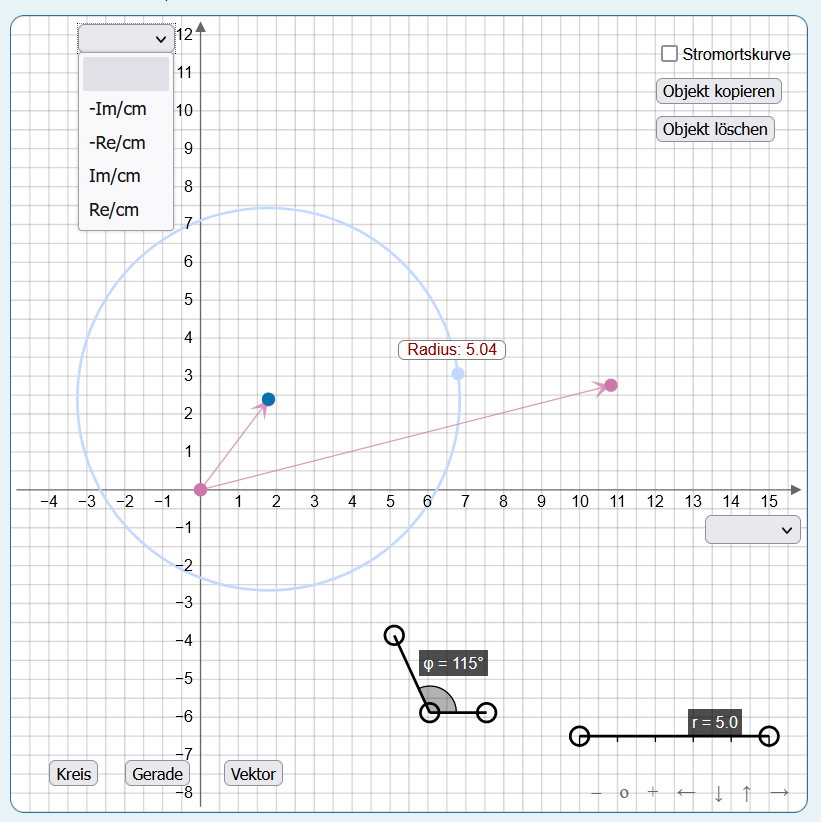
Through an iterative process based on the lecturer's requirements and regular feedback, a reusable drawing tool for the construction of current locus curves was developed. Using a dynamic coordinate display and the placement of simple geometric objects, it enables, among other things, the graphical determination of perpendicular bisectors. Additional tools for measuring angles and distances make it possible, for example, to identify specific operating points.
The current locus curve tasks will be made available in the summer semester of 2024 as part of a voluntary practice test. Each new attempt at the test presents a randomly selected task on the topic of current locus curves.
Automatic assessment of laboratory exercises in the Cyber-Physical Systems 1 module
Project duration: 08/2023 - 01/2024
Client: Prof. Dr. Michael Wiehl
Faculty: EMI
A digital laboratory notebook already existed for the Cyber-Physical Systems 1 module, providing laboratory exercises for robot programming. However, it contained many free-text tasks, resulting in a significant marking workload.
The Service Centre for Digital Assignments was responsible for implementing the following elements:
- Reduction of maintenance and marking effort through the use of CodeRunner tasks for all programming exercises
- Development of a library for integrating the sensor language into CodeRunner
Revision of the aptitude test for the Artificial Intelligence for Industrial Applications (MAI) master's programme
Project duration: 08/2023 - 12/2023
Client: Prof. Dr. Michael Wiehl
Faculty: EMI
Following the positive experiences with the admission process for the winter semester 2023/2024 for the Artificial Intelligence for Industrial Applications (MAI) master's programme, the aptitude test was continued in the following semester. A particular focus was placed on incorporating lessons learned from the previous semester in order to prepare applicants even more effectively.
The Service Centre for Digital Assignments was responsible for implementing the following elements:
- Revision of the preliminary test based on responses from the previous semester, including the partial redevelopment of tasks
- Modification and extension of the aptitude test randomisation
- Technical support during the test sessions
Implementation of digital examination tasks in the field of Business Administration
Project duration: 06/2023 – 07/2023
Client: Prof. Dr. Thorsten Hock
Faculty: WEBIS
Based on task concepts provided by the lecturer, seven STACK tasks with a large number of sub-tasks were developed. Some of the task concepts included tabular data for different randomised variants of the tasks. These were first reformatted by the Service Centre using a custom script and subsequently integrated into the STACK tasks.
Further development of the voltage waveform drawing tool and integration into additional tasks
Project duration: 04/2023 – 07/2023
Client: Prof. Dr. Heiko Zatocil
Faculty: EMI
The Service Centre for Digital Assignments first simplified the maintainability, configuration and usability of the drawing tool. Subsequently, two additional practice tasks were developed using the tool and integrated into both the Power Electronics module and the Control of Electrical Drives module.
Development of an aptitude test for the Artificial Intelligence for Industrial Applications (MAI) master's programme
Project duration: 03/2023 - 07/2023
Client: Prof. Dr. Michael Wiehl
Faculty: EMI
In anticipation of a consistently high number of international applicants (>200 per semester) with a wide range of academic backgrounds, a digital competency test in Mathematics and Computer Science was introduced as part of the admission process for the new international master's programme Artificial Intelligence for Industrial Applications (MAI).
The Service Centre for Digital Assignments provided support as follows:
- Implementation of a preliminary test containing syntax and practice tasks based on a predefined concept:
- 12 Mathematics tasks using STACK
- 7 Computer Science tasks using CodeRunner
- Implementation of the competency test based on a predefined concept:
- 15 randomised Mathematics tasks using STACK
- 11 randomised Computer Science tasks using CodeRunner
- Population of the Moodle course with explanations, FAQs and a wiki
- Technical support during the test sessions
Implementation of lecture-related practice tasks for Electrical Engineering
Project duration: 01/2023 – 11/2023
Client: Prof. Dr. Peter Wiebe
Faculty: WIG
For an Electrical Engineering lecture within the Medical Engineering degree programme, 25 digital tasks were created based on written problem sets and enhanced with randomisation, interactive graphs and automatic feedback. During the semester, these were made available to students through four voluntary practice tests, allowing them to practise specific lecture content at their own pace using different numerical examples. An additional test on significant figures served as a preparatory assessment.
2022
Implementation of digital examination tasks in the field of Statistics
Project duration: 12/2022 – 02/2023
Client: Prof. Dr. Thorsten Hock
Faculty: WEBIS
Based on task concepts provided by the lecturer, eight STACK tasks with a large number of sub-tasks were developed. A distinctive feature of these tasks was the conditional dependencies between the individual sub-tasks, meaning that different answer options were correct depending on the randomised variant. Following feedback from the lecturer, minor adjustments were made and the randomised variants were created.
Implementation of tasks for a mock examination in the fundamentals of Economics
Project duration: 09/2022 – 12/2022
Client: Prof. Dr. Horst Rottmann
Faculty: WEBIS
Based on task concepts, three STACK tasks with multiple sub-tasks were developed for a mock examination. Particular attention was paid to error tolerances, input guidance and the handling of consequential errors. Following feedback from the lecturer, final adjustments were made and a sufficient number of randomised variants was created.
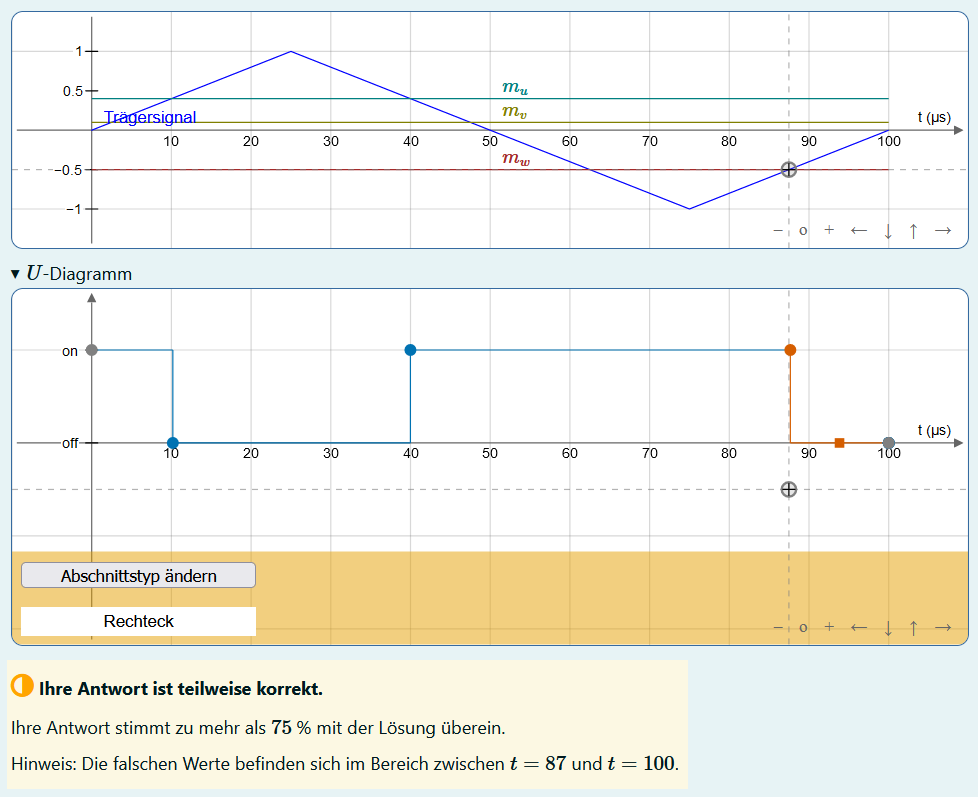
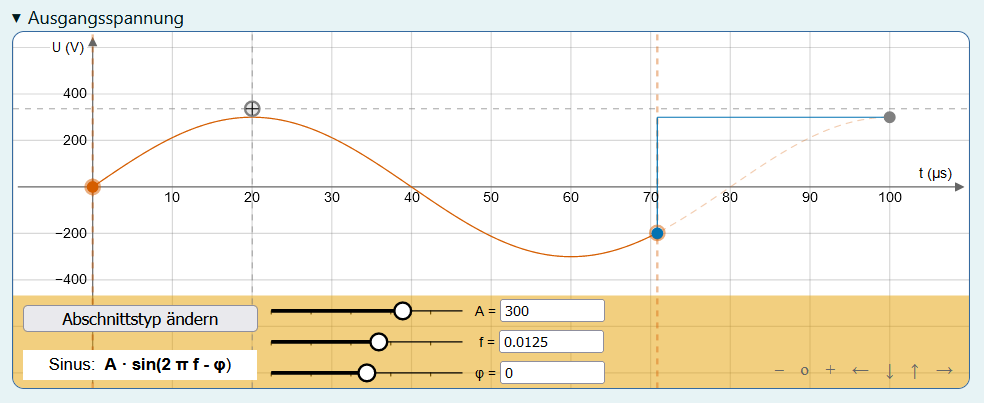
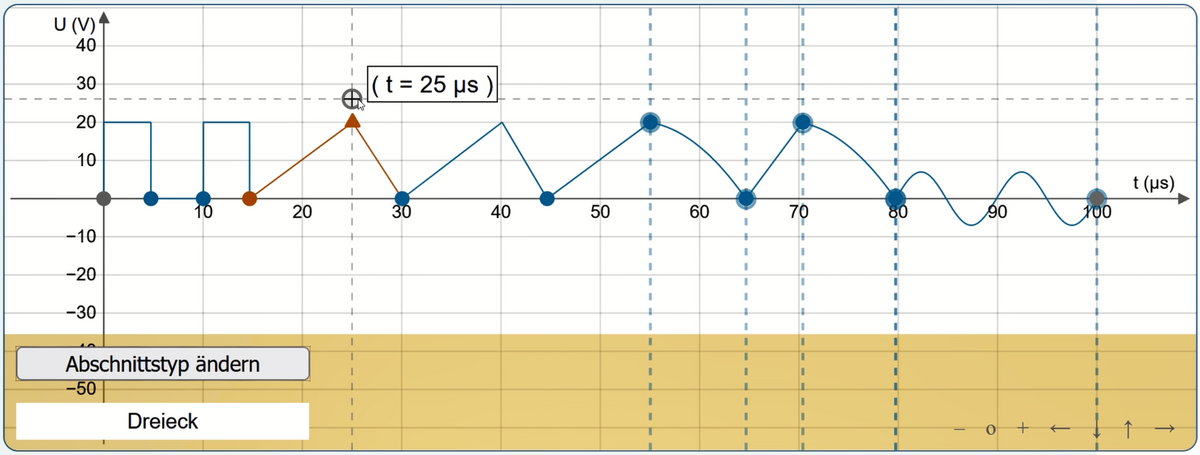
Development of a voltage waveform drawing tool and integration into the Power Electronics course
Project duration: 07/2022 - 12/2022
Client: Prof. Dr. Heiko Zatocil
Faculty: EMI
In this project, a paper-based exercise sheet from the Power Electronics lecture was converted into a digital task and made available to students for repeated practice.
A distinctive feature of the task is that, in addition to entering simple calculation results, it includes a more advanced drawing tool for the graphical input of switching waveforms. Students can construct switching and voltage waveforms from multiple segments and have their answers automatically assessed. Feedback is provided based on the similarity of the submitted solution to the model solution. Thanks to the implemented randomisation, the task can be repeated multiple times with new values.
It is planned to further develop this input method and use it in the future for Electrical Drive Engineering and Mechatronic Systems courses as well.