
Structure
Contents

Artificial Intelligence (AI) has become indispensable in the industry – whether in training cooperative robots, optimising processes or quality assurance.
The Master's programme in Artificial Intelligence for Industrial Applications gives you deep insights into how artificial intelligence works. It addresses current topics such as machine learning, natural language processing and computer vision. Solid theoretical principles and the current state of research are taught. The programme enables a practical and application-oriented education, in which you will design and prototype AI systems in practical projects in small groups. You will be taught by professors with strong research backgrounds and lecturers from the field of AI. They will provide you with the necessary knowledge to be able to work in the digital working world with a Master of Science degree.
The study programme addresses exciting future-oriented topics. In lectures you learn how to analyse data, train and evaluate AI models. Work is done in projects in teams or individually in seminars or in self study. You will work on the most up to date technologies in challenging applications. Electives modules show different applications mainly in smart factories. However, other domains like energy sector or medical technology are adressed as well in order to prepare for different career opportunities.
Our modern AI labs are well equipped with the latest technologies and high-performance GPU computers. Our professors and lecturers have acquired their knowledge at international universities and relevant research institutions.
Course of studies
A typical study plan consists of theory semesters and one full time semester for Master Thesis. How many theory semesters are planned depends on your study mode.
Within the bridge semester you will be able to get to the campus, get familiar with university life (administration, online learning, curriculum) and get know the rich culture in the region.
This semesters gives you the opportunity to fill gaps in competences, which are necessary for further study. Different courses are offered in winter and summer term. You will learn how to organize in teams, plan projects, write reports with scientific methods, do problem based learning and gain intercultural competence.
In the following semesters, you will learn the most important fundamentals and practical skills for the successful use of modern AI technologies. In the process, you will test and explore the use of artificial intelligence in the context of various application scenarios in several practical projects. In addition to subject-related content, you will be prepared for your everyday work as a Master of Science in courses on scientific writing and other soft skills.
You can choose elective modules on topics like AI security, embedded intelligence or energy management with AI methods.
In the last semester, you will plan and execute your own research project. You will discuss research ideas and results. At the end you will write your master thesis.
Teaching is done in lectures, seminars, self study, project work and laboratory practice.
The language of instruction in all modules is English.
Upon completion of the program, you will receive the academic degree "Master of Science (M. Sc.) for Artificial Intelligence for Industrial Applications".
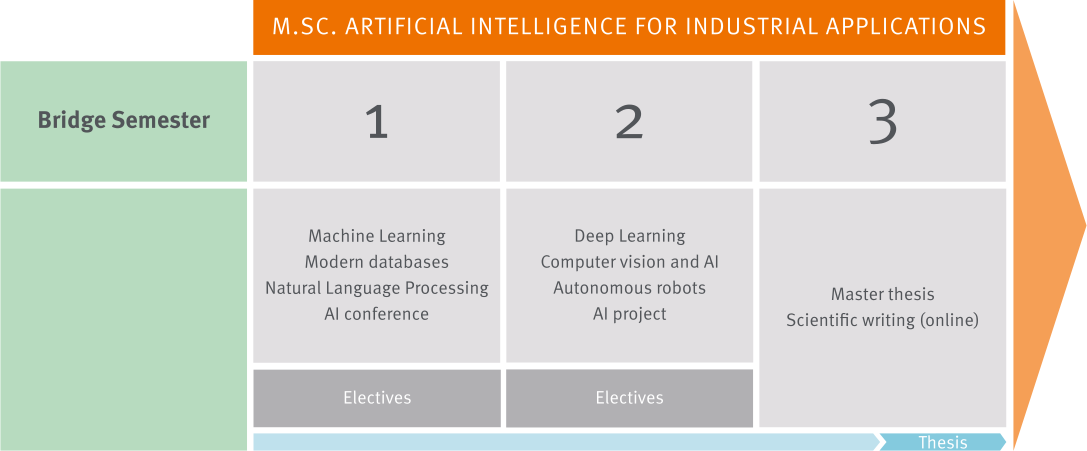
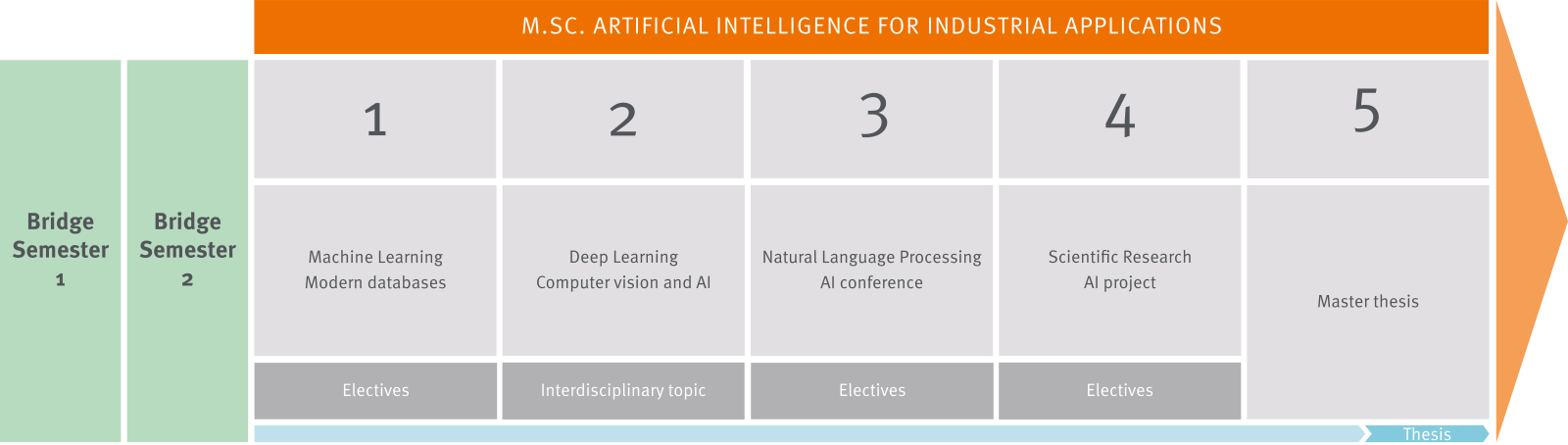
Please refer to the current course catalogue, which contains all study plans.
Full-Time and Part-Time Study
Students in our Master’s programme can study either full-time or part-time. Both study models lead to the same Master’s degree, include the same academic content and examinations, and are taught entirely in English. The main difference is the workload per semester and the flexibility of the study schedule.
Many students begin their studies in the standard full-time model and later decide whether part-time study would better fit their personal situation but if you are planning to work alongside your studies then studying part-time from the beginning is also helpful.
Full-Time Study
Full-time study is the standard study model and is designed for students who want to focus mainly on their academic studies. Students usually complete approximately 30 ECTS credits per semester, resulting in a more intensive workload but a shorter overall study duration.
A typical study structure includes:
- A bridge semester with additional preparation modules
- Three semesters of the Master’s programme
- Practical projects, laboratory work, seminars, and self-study
- A final Thesis in the last semester
This option is particularly suitable for students who:
- Want to complete the programme quickly
- Have limited employment or external commitments
- Prefer a more structured and intensive academic schedule
Part-Time Study
Part-time study offers greater flexibility by reducing the workload to approximately 20 ECTS credits per semester.
This option is especially helpful for students who:
- Work part-time during their studies
- Need additional flexibility due to family, responsibilities or health
Many international students choose part-time study because they are balancing:
- Employment alongside their studies
Part-time study allows students to progress through the programme more sustainably while reducing academic pressure.
Full-time vs Part-time side by side comparison
| Full-Time Study | Part-Time Study | |||
|---|---|---|---|---|
| Approx. 30 ECTS per semester | Approx. 20 ECTS per semester | |||
| Higher study workload | Reduced study workload | |||
| Shorter study duration | Longer study duration | |||
| Less flexibility | More flexibility | |||
| Suitable for students mainly focused on studies | Suitable for students balancing studies with work or other responsibilities |
Important Information
Students studying part-time must still complete:
- Obligatory bridge modules and German language requirements within the required programme timeframe of 1 year.
Careful study planning is important in both study models because some modules are only offered in specific semesters. Students who are considering changing to part-time study are encouraged to review their workload early and seek academic advice if needed.
Contact us for further information regarding study planning or switching between full-time and part-time study
Documents
Study Plan
The study plan presents the modules of the Artificial Intelligence for Industrial Applications degree programme in chronological order over the semesters. Here you can find out which lecturers are holding lectures in the current semester. In addition, you can find out which coursework and examinations have to be completed.
Please also have a look at the current study plan in the course catalogue.
Course Catalogue
The course catalogue describes the modules of the Master's programme Artificial Intelligence for Industrial Applications and the courses they contain. You can download the course catalogue for the Artificial Intelligence for Industrial Applications degree programme as a PDF.
Timetable / Examination Schedule
You can download the current timetable, as well as the current examination schedule and the lecture hall allocation for the Artificial Intelligence for Industrial Applications degree program in PDF format.
Study and Examination Regulations
The currently valid study and examination regulations for the Artificial Intelligence for Industrial Applications program can be downloaded in PDF format.
- Study and Examination Regulations Master Artificial Intelligence for Industrial Applications of 16.02.2023 (in German)(246 KB)
Valid for studies beginning in summer semester 2026
- Study and Examination Regulations Master Artificial Intelligence for Industrial Applications of 16.02.2023(422 KB)
Valid for studies beginning in summer semester 2026
- Study and Examination Regulations Master Artificial Intelligence for Industrial Applications of 16.02.2023 (in German)(207 KB)
Valid for studies beginning in winter semester 2023/2024
- Study and Examination Regulations Master Artificial Intelligence for Industrial Applications of 16.02.2023(347 KB)
Valid for studies beginning in winter semester 2023/2024